Showing posts with label setting. Show all posts

Wednesday, May 3, 2017

My Home, My Setting

by Ruth Ann Dell

A Gifbal (Wildflower)

Reindeer food, snowy forest scenes and lakes, golden domes and spires, colorful ornate churches, a pink padlock embellished with hearts on a bridge filled with lovers' padlocks, nesting dolls and fancy shoes fill my laptop screen in turn as my friend shares some of the sights of her holiday in Finland and Russia with me. I can only imagine the sounds, smells, aromas, flavors and textures that surround her and fill her senses. Wonderful experiences which will translate into exotic settings in her novels in days to come.

And here I sit in my house in South Africa. Same old same old, as we say here—nothing new or interesting to use in my books.

But if I stop and think about it, I realise that's not true. Although so familiar to me, my surroundings are interesting and different to that of many readers living in other countries.

I take for granted the single layer of glass in my windows which allow sounds to be heard indoors. When a Scandinavian visitor to the country first arrived and heard the birds outside, she asked in alarm what the noises were that she could heard. It was a totally new experience for her as the double glazed windows and paucity of birds in her home city meant no outdoor sounds penetrated the rooms of her house.

Bird song and calls are an integral part of my life. At night I sometimes hear the soft hoo-huuu of a spotted eagle owl or whi-whi-whi-WHI-WHI-WHI-whiwhi of thick knees as they go about their nocturnal business. I wake to the sound of dinosaur-like birds (hadedas) shouting raucously in the sky, accompanied by twittering of garden birds and the cooing of doves. During the day I often hear crested barbets trilling away and sounding for all the world like old-fashioned telephones ringing. The gray lourie or "go away bird" orders me to "Go-waaaaaay".

And it's not just the birds which make my garden unique .It's also the sound of the weather, especially our amazing Highveld thunderstorms. The day can be bright and sunny without a cloud in sight, and suddenly the sky darkens and before you know it, rain comes lashing down and pounds on the windows so loudly that  you cannot hear the TV even with the volume turned up. Sometimes hail attacks the windows too and adds to the cacophony. We jump out of our skins at loud cracks of thunder. Through the windows we see the street awash with water so that it appears to be a river. But half an hour later the sun is shining again, the river has disappeared and steam rises from the surface of the street.

I thought storms were like that everywhere until I went to Ireland. Thunderstorms are not as common there, but there's plenty of wind and rain, and often for days on end. As I stood in my sister's house looking out of her double glazed windows, I found it really strange to see the trees bent over with the force of the wind as the rain ran down the windows—but there was no sound, the world was on mute! And the sun did not shine at all. The day was dull and cloudy with none of the exhilaration of a South African thunderstorm.

Another thing that I love about living here is that there is that the Klipriviersberg Nature Reserve is a only short drive away. It's a unique experience to walk there as wildlife roams free. On one early morning hike, our group of hikers was greeted with the forms of several zebra rising up out of the mist by the ruins of an farmhouse. We passed so close to them that we could hear them chewing.

A Zebra
Later as the sun rose we spotted wildebeest and several species of buck. Birdlife and wild flowers abound and delight visitors.

A Wildebeest
And so I have come to realise that my surroundings are unique and interesting, in fact they make the perfect setting for my characters!

I'll end on a visual note with photos of some of the wild flowers in the reserve.


Now over to  you. I'd love to hear where you live and what makes your surroundings unique? Can you use the world around you for the setting of your novel?


Wednesday, October 19, 2016

The Moment I Realized Setting Can Make or Break a Story

Guest Post by N.J. Lindquist


I’m one of those people who skip over descriptions. Honest. I do it all the time. The author starts going on and on about what the weather is like, or how the house looks, or the beautiful painting, and I completely zone out. Well, unless it’s a whodunit and I suspect the author has a clue hidden somewhere in the verbiage. But even then, I’ll likely skim if the description goes on too long. So when I began writing I have to confess that I focused almost solely on the characters and then the plot.

Oh, I included a setting—you have to locate the story someplace—but it was vague at best.

For my first book, which was originally published by Moody Press, I used a mythical, very vague small town I called Wallace. Since I was raised in small prairie towns, it was easy to envision a small town somewhere in the US or Canada.

When I wrote the second book in the series, With Friends in Need, I realized that I needed a bit more information—like how many blocks did Glen have to walk to get to school, to his best friend’s house, or to the bank his dad managed? And what did he pass on the way? So I created this Bristol board map of Wallace. And I used this beauty for the next two in the series, too. For me, that was what setting was—the locations, large or small, I used in the story.


My first two mysteries (which are published under my alter ego, J.A. Menzies) weren’t much different. The ideas for the books actually began with settings: a Japanese garden in Vancouver and the Rogers Centre in Toronto. But I continued to write in what I call the “Talking Heads” style. Lots of dialogue and action, but very little description of any kind. After the second draft was complete, I’d go through and add bits of description here and there to help my readers see what I saw in my mind: both the characters and their setting.

Then one day I started on a fantasy chapter book for my eight-year-old granddaughter, who had requested a book for “her age.” As usual, I began with a vague “some other world “setting, and focused on the characters, the action, and the dialogue. I’d fill in the details later.

About a third of a way into the book, while writing a scene with my talking horse, who was going on a journey, I shook my head and stopped writing. This felt wrong. The talking horse thing has been done before, and I didn’t want to compete with C.S. Lewis. After due diligence, I decided I should have a camel.


Since I don’t edit while I’m writing the first draft, I exchanged the word “camel” for “horse” in the sentence I was on and kept writing as if the animal had always been a camel. Except—I couldn’t just keep writing. In my mind, my horse had been trotting through a green valley with trees and grass and a river, but my camel was plodding through a hot desert, with an ocean of sand in every direction, and just a vague glimpse of distant hills.

And at that moment, it hit me how important the setting is to the story.

I still prefer to use only essential details, but although much of what I “know” about the setting never appears in my stories, I spend a lot of time creating my settings and determining how they relate to my characters before I outline my plot.

They say write “what you know” and I’ve always tried to start my writing with something I know about, and let my creativity flow from there. Now I’m also likely to begin with “where I know.”
I just finished writing a mystery novella called The Case of the Homeless Pup. The plot for this book begins on a path in Toronto’s Don Valley where I’ve walked a number of times.


In my book, a jogger spots a puppy on the path ahead and follows it deep into the woods where he finds a human skull. The plot moves from there to a downtown area whose streets I’ve also walked. Readers who are familiar with my locations have told me they feel one of my characters might come around the next corner. I feel the same way. And I love that feeling!

N.J. Lindquist is an award-winning author, speaker, and writing teacher who loves helping people become everything God created them to be. Her published work includes five YA coming-of-age novels, the Hot Apple Cider anthologies, and the Paul Manziuk and Jacquie Ryan Mysteries (as J.A. Menzies).

A former high school teacher and homeschooling pioneer, N.J. has been mentoring writers in both Canada and the United States since 1992.

The mother of four and grandmother of eight lives in Toronto, Ontario.

http://www.njlindquist.com
http://jamenzies.com


Monday, June 20, 2016

On-the-Ground Setting Research


Whether you set your stories right where you live, across the country, or elsewhere in the world, you'll need to research your setting. If your story is set in a galaxy far, far away, I give you permission to make everything up.

Research for your hometown or somewhere else you're very familiar with takes a different shape, for sure. You'll need to decide how much to fictionalize in any real setting. Business names? Street names?

But let's pretend for a few minutes that you plan to set your story or series somewhere you are less familiar with.

Can you visit the setting?
If so, do it! Unless it is near enough to visit often, plan your trip carefully so you can be sure to get the information you need in one trip. If you're visiting in spring but writing a Christmas story, keep that in mind, too.

• Take a digital camera with an extra battery and an extra SD card. You definitely don't want to lose the capacity to record the details partway through your day.
• Take a lot of photos, including of signs. A recent one-day trip to Spokane, Washington, for my upcoming series resulted in over 300 images. Some of them were easy deletes when I returned home and processed them, but most stayed in the album. I often open this digital album when writing.
• Take a map you can write on, especially if you plan to use the setting "as is." Make notes on it!
• Close your eyes. Smell. Hear. Feel. These are important senses, and the information you absorb by focusing on them are much harder to get from online research. Make note of these in a notebook.

Can't go?
All is not lost if you cannot visit the setting in person. Online research is your friend!
• Google
• Wikipedia
• YouTube
• Google maps/street view
• Blogs
• Flickr
• Join a "local" FB group and read the listings.
• Contact the tourist info with specific questions

Know someone who lives there?
• Ask for a one-hour interview on Skype or a Google Hangout before starting to write. Ask what they like and dislike about where they live. Mostly listen, and keep good notes.
• Ask if they will beta read your story and point out setting errors.
• Ask questions via email during writing. Keep the questions specific so as not to waste their time.


I wrapped up my Farm Fresh Romance series in February with the release of the sixth book. For a few months before that, I spent time making decisions about the next series. I decided to create a spin-off series in an urban setting and, after much deliberation, chose Spokane, Washington. It is close enough both to the fictional setting of FFR and to where I live in Canada that I knew I could nail the setting.

I combed through Spokane on Google maps, looking for the right neighborhood. When I found a likely prospect, I switched to "street view" and went up one street and down the next, taking in the surroundings as much as the program allows. My husband was up for a one-day road trip, and off we went.

Thankfully the area was just as inviting in person as it had seemed in Google maps. We ate lunch at the neighborhood diner, walked along the river, climbed the sidewalk stairs from one street to the next, enjoyed glimpses of a fat gray squirrel and a golden-mantle marmot, listened to the birds sing, and walked amid the raised beds in the community garden.


All of these things became backdrops to Secrets of Sunbeams, the first book in my new Urban Farm Fresh Romance series.


Good fences make good neighbors.
Especially if your neighbor is a goat.

Eden Andrusek knows she should have fixed her fence last week. It’s too bad her runaway goat makes a less-than-ideal first impression on her new neighbor, who turns out to be cute, brilliant… and a little uptight.

Solar architect Jacob Riehl is furious when he returns outside to find a goat eating his presentation. As someone who likes everything in its place, he has little sympathy for a farm animal in the city or its tattooed owner, but there’s something about the lovely Eden that captures his attention.

What will it take to win over a man whose only pet was a goldfish? And how long can Jacob and Eden go without addressing the goat in the room?


Secrets of Sunbeams releases first in a multi-author box set, Whispers of Love, which also features a novel by ICFW member Marion Ueckermann plus ten other contemporary romance novels. If you haven't pre-ordered your copy of Whispers of Love, don't delay! The fantastic price of $0.99US is only guaranteed until July 4.

Click here for more information or to order for Kindle, Kobo, Nook, or iBooks.

Valerie Comer's life on a small farm in western Canada provides the seed for stories of contemporary inspirational romance. Like many of her characters, Valerie and her family grow much of their own food and are active in the local food movement as well as their church. She only hopes her creations enjoy their happily ever afters as much as she does hers, shared with her husband, adult kids, and adorable granddaughters.


Valerie writes where food meets faith and fiction in her Farm Fresh Romance series and Riverbend Romance novellas. Visit her at ValerieComer.com.

Tuesday, May 31, 2016

Lo amo l'Italia!

By Lisa Harris

When I first start writing almost twenty years ago, the settings of my stories were pretty random and never played an intricate part of the story. But over the years, both through writing and reading, I've learned that not only is setting key, it can actually be weaved into the story like another character. Whither it's a South African game farm, the Smoky Mountains, or the barren Sahara desert, the setting can be used not just to anchor a story, but to make it come to life.


Last summer, knowing I was going to write a book set in Italy, our family was able to fly into Rome on our way back to the United States. I've just now started working on the story--another fast paced Romantic Suspense--and the chance to actually visit cities like Rome, Pisa, and Venice, has given me additional details and insight into the country that goes beyond internet research. 

Since I've started writing, I'm enjoying going back through my notes and photos, I thought I'd share some of my favorite photos from our trip.


What about you? What book have you read lately that does an excellent job of weaving the setting into the story?
_____________________________________________________________________________

LISA HARRIS is a Christy Award finalist for Blood Ransom and Vendetta, Christy Award winner for Dangerous Passage, and the winner of the Best Inspirational Suspense Novel for 2011 (Blood Covenant) and 2015 (Vendetta) from Romantic Times. She has over thirty novels and novella collections in print. She and her family have spent over twelve years working as missionaries in Africa. When she's not working she loves hanging out with her family, cooking different ethnic dishes, photography, and heading into the African bush on safari. For more information about her books and life in Africa visit her website at www.lisaharriswrites.com

Monday, October 8, 2012

Resemblances of Real Life Locations


Sometimes the settings in my head for fictive stories are strictly the product of my imagination, though it’s been said there’s nothing new under the sun. Other times I’m fully aware that I’ve been inspired by real life locations. In fact, I will occasionally have a place in mind where I’ve visited or have seen before via photographs that captured my attention and deepened my interest.

I recently undertook a genre swap from romantic political intrigue set in Argentina to a work of fantasy romance. Working on an eNovella series with six installments, the first soon to be published by Soul Mate Publishing, the location from which to draw inspiration for eNovella #1, Wind’s Aria, came to mind near the beginning of the venture.

Have you ever seen pictures of the Plitvice Lakes in Croatia? Or perhaps you live in the region; after all, we are a very international group here. Needless to say, it’s gorgeous—and naturally looks like a realm that belongs in a delightful fairy-tale.

As once a member of an internationally acclaimed Croatian dance ensemble, I was first introduced to the Plitvice Lakes National Park twenty years ago. It made such an impression on me that I knew someday it would stir something more, further awakening the creative aspect in my life.

So as I started writing Wind’s Aria, it dawned on me that I was painting a picture resembling this real life location that made such an imprint on me many years ago. Once I realized this, I studied the images of the Croatian lakes online, clipped out photos from magazines, and examined travel logs. I stretched the region out on my mental canvas and then began adding more of my own embellishments, such as a bridge here, a dock there, a cottage or garden, livestock, the people, form of dress and culture for a timeless generation in a literary sphere of fantasy.

One thing I noticed . . . if a touch of writer’s block hit me I only had to pull out those images of the real life region, take a deep breath while admiring the beauty, and I was on my way to plotting the story again.

What about you? In the world of fiction, in whichever genre you dwell, do you find your inspiration from real life locations, basing stories around places and settings that actually exist? How do you keep these locales fresh in your mind?

As someone who appreciates other places and cultures, and who loves the world of fiction—both as a writer and a reader—I’d love to hear about the regional resemblances in your work-in-progress stories!

Tessa is a veteran of the performing arts and worldwide missions, having come from a long line of musical arts professionals. She loved seeing the world and absorbing the beauty of other cultures . . . an enriching life full of dance, music, faith, and interesting cuisine. She’d always dreamed of becoming a romance writer, conveying words that inspire and the thrill that occurs when two destined souls meet. www.TessaStockton.com
 

Monday, April 19, 2010

How Much is Too Much?

Good Monday morning. Alice Valdal here with a burning question for readers everywhere.


Can you have too much detail in a story?

Too much setting?

Too much historical fact?


The answer, of course, is yes.


In my WIP, an historical that takes place over three years, I've used newspaper snippets at the top of each chapter to show a flavour of the era and the passage of time. My first reader just flagged all of them as boring. Ouch! As a history buff, Ifind them extremely interesting. So, what do readers want? Is the price of wheat in 1903 interesting to you? It is a prairie tale


At my book club this week, there were complaints that an author had used no description of various characters. In fact, the novel in question had several female characters and we couldn't keep them straight. They seemed like mere names on the page. Now, to make a character truly come alive, we need to know about her dreams and fears and goals and motivation and conflict, but many of the readers at that meeting wanted some description of what the character looked like, too.


So, as authors who write from a variety of locales, do we fill our books with local colour? I just read a set of guidelines that stipulated the publisher wanted a mini-travelogue in each romance story. Yet others have complained that too much attention to the type of architecture or the natural flora detracts from the story.


Personally, I like to feel the heat and dust if I'm reading about Africa or the Outback of Australia. I want the crisp, clear air of the Rocky Mountains, or the salt tang of a Nova Scotia seaport.

Details, details. How much is too much?


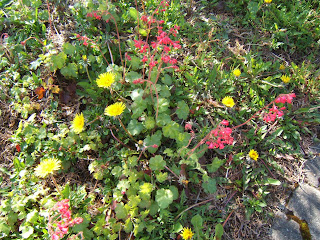
I conceived the notion for this article while weeding in my garden. Do you appreciate this photo of Coral Bells more or less for knowing my struggle with the dandelions?


Do you want to know if my heroine has blue eyes? Do you care who was King in 1910?


For more details about me, check out my webpage at http://www.alicevaldal.com/


Thursday, January 14, 2010

Homework, Fieldwork and the Fun of Setting Research - LeAnne Hardy

On Monday Cathy wrote about her novel manuscript set in Viet Nam.  One of the fun parts of writing international fiction is the travel. My first two books were set in places I knew well because I had lived there. When I wrote Glastonbury Tor (part historical fiction, part fantasy of the Holy Grail) I had lived in England, but not in the sixteenth century and not in Somerset where Glastonbury Abbey was located. I needed a visit to soak up the details that would create the atmosphere I wanted. Here are some things I learned about researching my setting.

Do your homework.
The public library provided me with more than thirty books about medieval and Elizabethan life in England, the monasteries, and the Dissolution under King Henry VIII. I was surprised at how many books I found specifically about the history and geography of Glastonbury. (Libraries are the best thing about living in a developed country—that and fast internet.) Descriptions stimulated my imagination and filled my mind with elements for my story. Besides all the notes on facts and plot ideas, I soon had a list of places I wanted to see in person.


Keep a journal. 
This is not only what we writers to do, it is also a good way to convince the IRS that your travel was a business expense. I found that I alternated scrawls of information with pages of dialog and description as they came together in my head at the site. It didn’t hurt that my hosts loaned me a bicycle to take the canal path into town through a nature reserve. The bird hide with a view of the Tor (Celtic for ‘hill’) was a perfect place to gather my thoughts and think about what my characters would do with what I had seen that day. One evening I came upon the starlings roosting in the reeds of one of the bogs that still dot the Vale of Avalon. That experience became a key romantic scene in the book. Fog creeping out of the bog across the bike path found its way into a darker scene. The day I climbed the Tor in the rain, I rushed home to the farmhouse where I was staying and drafted the scene when Colin climbs the Tor, visiting the Stations of the Cross in an effort to purge his soul. Of course, it is raining in that scene.

Use a digital camera to take notes. 
After all, a picture is worth a thousand words. The photograph of the monastery wall edging High Street reminds me of its height and the crenulations along the top. I take pictures of signs  to remind me of where the next pictures were taken or to be studied for information later (being careful not to position the flash so it produces a glare that makes the sign unreadable.) One of my numerous shots of the photogenic Tor became the basis for the book’s cover design.

Buy a geological survey map of the area. .
These are sold in shops for hikers. Mine not only kept me from getting lost in my rambles, but I also spread it on the floor of my study back home to plan the approach of King Henry’s men and Colin’s route in search of the stolen Grail.


Local people are great resources
When I visited Glastonbury, I stayed with a family I found by contacting a local church and explaining who I was and what I wanted to do. I offered to pay for hospitality--something that was hard to convince my new friends to accept in the end. They filled my ears with local data and later checked my dialog for authenticity. When I went to Wales to research a sequel (my current work-in-progress) I took advantage of the local Rambler’s Associations. These groups organize country walks. When my fellow walkers found out why I was there, they were eager to suggest other locations I should visit. One hike proved to be shorter than expected and half the group accompanied me to a near-by waterfall they thought I should see. I would never have found the location on my own, but it was the perfect inspiration for several key scenes.

What books have you read whose setting most interested you? Is there a dream setting you would like to visit?

______
LeAnne Hardy has lived in six countries on four continents, sipped cream tea in Oxfordshire, eaten stewed goat at a Mozambican wedding, slid down rocks in a Mato Grosso river and shopped at Mall of America. Her books for young people come out of her cross-cultural experiences and her passion to use story to convey spiritual truths in a form that will impact lives. Visit her at www.leannehardy.net