Showing posts with label character development. Show all posts

Thursday, June 28, 2018

Three Attitudes that Give Impetus

Beatrice, Irene, and Dora
As I can't picture three attitudes, I thought my grandmother, and my two great aunts might just capture these mental positions.

1. Need
A leading character, either male or female or both, should have some sort of deep need.

2. Determination
If they want to reach their goal, this is necessary to reaching it.

3. Hope
This is that wonderful something to keep striving toward.

Need can be physical or mental. And it can be a real struggle for your character to face the challenge to overcome and when they have the odds against them. They remain conscious of their need throughout the story. Maybe others are aware of it, maybe not, but it's as if it mocks all their efforts.

Determination can also be considered as Perseverance. As we say, 'hanging in there' no matter what. We want to root for our main character - though at times bloodied and nearly beaten - to hold on and come through. Maybe at times with so much thwarting them at every turn they feel like giving up, but still they 'grit their teeth' and get on with pushing toward their goal.

And Hope. What would be do without it? Hope gives us courage. Hope promises better things. Hope helps push us forward. And so with our characters.

As in real life, the great thing is to see our leading lady or man developing stronger characters by what they've been through. Even though, being human, they stumble along the journey, they pick themselves up and move forward.

As Christians we soon learn to trust God in every area of our lives, which means we often need to search out the root of our problem and ask the lord to help us overcome it. So if we write inspirational novels, let's also write our characters so they learn some great lessons along the way.

This is something I am working through right now with two stories, as part of a series. At first my characters were thin. But they are slowly developing as each is showing me throughout the plot how they would react. I am really liking them now. Even though at first I thought, "Oh, you're so boring!" There's no doubt throwing difficulties for them to overcome pushes the story forward, at the same time leaves me, as the writer, scratching my head as to how I am going to get them out of the trouble I've thrown their way. Thankfully, they just seem to find their own path, despite mean old me!


Indie Publisher, Rita Galieh, has written a trilogy of historical novels & has also contributed to several US anthologies. She is now completing a second historical romance series. She can be found on Facebook and www.ritastellapress.com  
Rita studied art at the National Art School then joined the family ceramics studio. After their marriage, she and her husband attended Emmaus Bible College, and currently co-present Vantage Point, an Australia-wide Christian FM radio program. She enjoys giving her fun-filled presentations of ‘Etiquette of the Victorian Era’ in costume.

Tuesday, May 3, 2016

The Most Important Thing

Of the elements of a novel, background is one of the most important to me. I often choose my reading based simply on where the books are set. To other readers plot is the most important—and, of course, one doesn’t have a novel without a plot. But underlying all, character has to be supreme. If a reader doesn’t care about the characters it really doesn’t matter a lot where they are or what they are doing.

And Sally Wright is a master of character. She has the ability to create characters one cares about so much that reading at times can be a painful experience. This capacity is well-known to Wright’s long-time readers of her superb Ben Reese Mysteries. And now, in the newly released second of her Jo Grant Mysteries she gives us a supreme example of her art.

As a devoted reader I believe I have read every exquisitely chosen word Sally Wright has written and I’m delighted to say that Behind the Bonehouse has reached a new level of excellence. As always, Wright knows her stuff: She knows chemicals, she knows horses, she knows the Kentucky landscape, she knows family business.


The thing that raises her writing so far above the ordinary, however, is her knowledge of human nature. Wright knows what it means to be a frail human being living in an imperfect world. She creates true-to-live, psychologically satisfying characters from a knowledge of the darkness of the heart of man that exceeds William Golding’s. Sally Wright knows good and evil.

And she makes her readers care deeply about the people who fill her pages because she cares so deeply. Let me give you an example. Esther Wilkes is anything but a major character, yet no one is unimportant to Sally Wright. Here is how she brings Esther onto the stage:

Esther Wilkes climbed out of her husband’s rusty red Ford pickup, pulling herself up with her right hand clutching the top of the doorframe.
     She was a large woman. What some might’ve called stout. But she was firm looking, and she stood up straight, and her small-striped tan-and-blue dress fitted well and was perfectly pressed. She’d made the dress so it fell halfway between her knees and her ankles, and she’d sewn a belt of the same fabric, though neither of them looked homemade. She was wearing stockings, in spite of the heat, with lace-up black oxford shoes with sturdy squared-off heels. She carried a large brown pocketbook in one hand and a handkerchief she’d embroidered in the other, and she waved it once at her husband, before she blotted her forehead, as he backed out of the driveway and headed to work in Midway.


Thomas Carlyle famously said of Frederick the Great, “Genius means transcendent capacity of taking trouble, first of all.” If Carlyle had known Sally Wright he would have said it of her.

Take a look at  Behind the Bonehouse.

Posted by Donna Fletcher Crow whose newest release in her Monaastery Murders clerical mystery series is An All-Consuming Fire

Tuesday, April 26, 2016

Not so Loveable - Character Development + giveaway

Axel ducked his head and rubbed a knuckle against his temple as a smile tugged at his mouth. “Truth is, Eliza, I wasn’t so sure about this whole arrangement, but after seeing you, I think I might be coming around. And not just because you’re as pretty as you are. When I saw you climbing down from that stage, it occurred to me the kind of courage it must have taken for a woman like you to travel all this way on your own. And I respect that. I don’t think marrying you is a decision I’m going to regret.” 
Elizabeth’s face warmed. Not from his praise, but from the fact that making him regret this marriage was foremost on her mind.
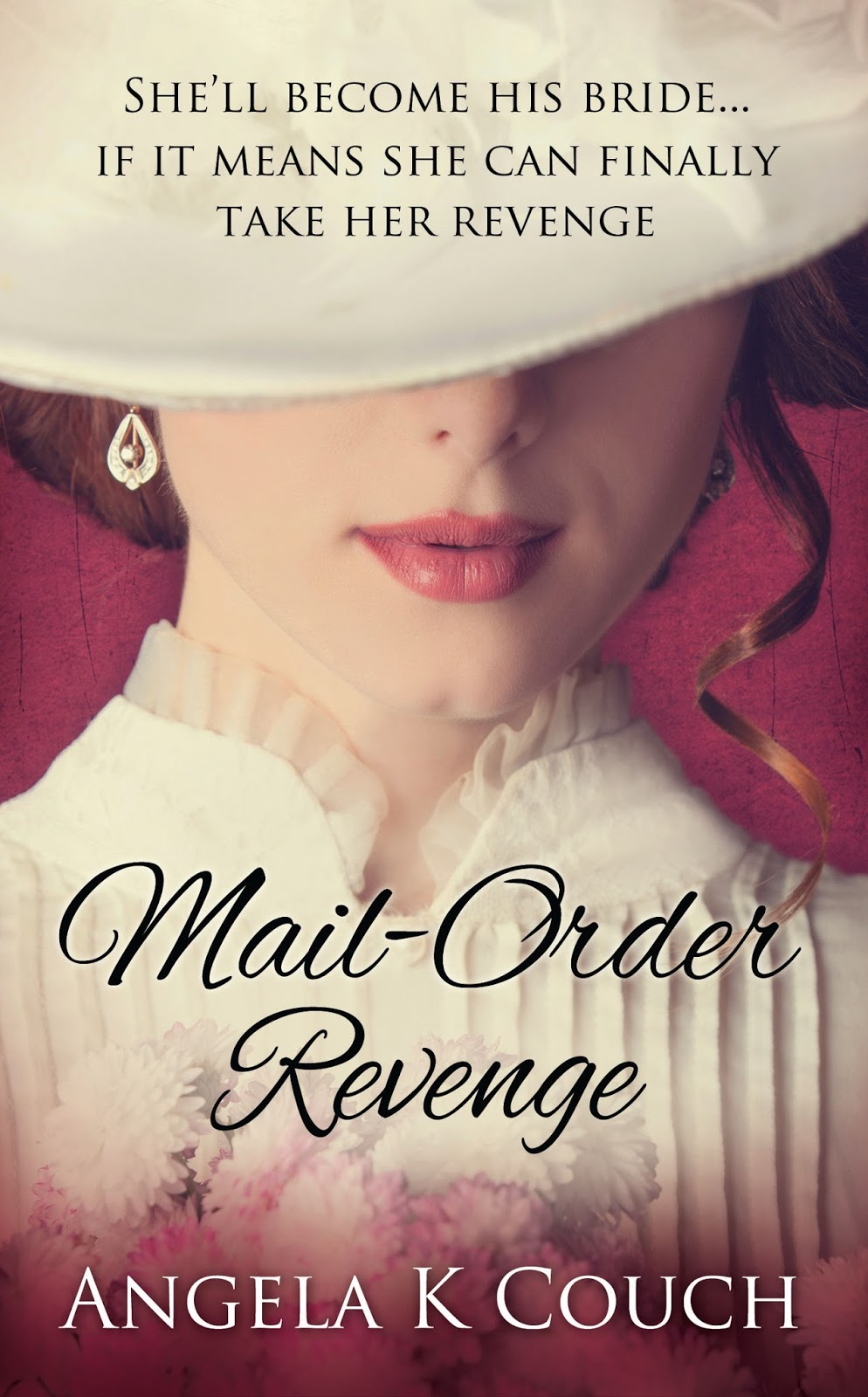
That is an excerpt from my newly released novella, Mail-Order Revenge


To give you a clearer picture of the characters, here is the back cover blurb:

Elizabeth Landvick knows of one man to blame for her family’s loss of fortune and her parents’ deaths. Now, she will stop at nothing to take her revenge and recover their wealth. Even travel across the country to marry the man’s son.  
With his on focus his sprawling Arizona ranch, Axel Forsberg has little time for wooing a woman, so when his father finds him a bride from the east, he trusts he won’t regret the convenience. Until horses go missing, barns burn to the ground, a range war begins…and he loses his heart. 

Starting out the story with a woman bent on making the hero's life miserable is fine and dandy until your readers fall in love with said hero and decide the heroine is a witch. After a while they can't read anymore because she makes them so mad.

While I love conflict, I must admit to having put down a few books because I could not understand the POV character and they were driving me mad. There are only so many times you can throw a book against a wall hoping to knock some sense into the main charactor before you don't pick it again...or have to take it in for repairs as in the case of an e-book. ;)

I had a similar problem when writing the Patriot and the Loyalist, (yep, this is a sneak peek at the cover!) the second book in my Hearts at War series (the first book is now available for preorder!) that will be releasing next year. For a time, a couple of my critique partners were ready to strangle the heroine--I mean, how heartless can a woman be? Especially when the Hero is trying so hard. Here are three things I learned from my beautiful British spy, and my vengeful bride...

1. Motivation: As I fed the reader backstory, I had to make sure it was clear what made the character the way they are. 
Have you ever read a book or watched a movie where you found yourself almost rooting for the antagonist and feeling a little bad for him when hauled away to jail after you learned he'd lost his mom as a kid, and then his dog got ran over, and Santa never brought him anything, and his ice cream fell out of its cone...Pretty much just one tough break after another? Lay all that history out for the reader and show how it affected the character. 
But, please, no info dumps! ;)

2. Motivation: What outside sources are at play? Physical threats? Perceived threats? The basic human instinct of survival? Are there events and situations that corner the character until the only way they see out of the problem is over or through someone else? 
A person can sometimes get away with murder if they believe it is self defense.

And next...

(Brace yourself for this one as it may come as a surprise.)

3. MotivationWhat is currently happening with the character's emotions that compels them to act so heartless? Where is their heart really at? What do they feel in the moment as they light that match and let it drop into a stack of dry hay...oops, no spoilers!

So the tall and short of it seems to be motivation and letting the reader in on that motivation...sooner or later. The timing is really dependent on whether you want your audience to like the character or hate them. 

What are your thoughts as a reader, or writer, about characters who drive you mad with their decisions. Leave a comment for a chance at a free e-book copy of Mail-Order Revenge. Now available on Amazon!

Angela K Couch is an award-winning author for her short stories, and a semi-finalist in ACFW's 2015 Genesis Contest. Her childhood was spent listening to her father read chapters from his novels, and Angela decided young to follow his path. As a passionate believer in Christ, her faith permeates the stories she tells. Her martial arts training, experience with horses, and appreciation for good romance sneak in there, as well. Angela lives in Alberta, Canada with her "hero" and three munchkins. 

Visit her at www.angelakcouch.com, or follow on Twitter or Facebook!


Monday, September 5, 2011

The Reason I Don't Read Much Modern Sci-fi


There must be something seriously wrong with me. Last week I was listening to an audio-book version of a modern sci-fi novel and there was this scene in which a baby was sucked out of a ship into outer space. I laughed. I know, it's terrible, but I actually laughed out loud.

Before you condemn me, perhaps it will help if I explain.

I chose this particular audiobook because it was published by Penguin and it had enough good reviews for me to take a chance. The author has written a number of books and is regarded quite highly. I have to admit that the book did have its strong points. The science was interesting (albeit over my head at times) and the plot kept me intrigued.

There were, however, three problems.

The first was that there was an almost total lack of character development. I've noticed this as something of a feature in the "hard" sci-fi stories I've tried recently. When it comes to a plot in which the characters are essentially facing a live-or-die scenario, you should at least care whether or not they live or die. Sadly, in this last book, I honestly felt as though the people were just names. I didn't care for them one jot.

The second problem was that the story felt a little like an instruction manual. It was basically all tell and no show. At the half way point I realized that I couldn't remember hearing a single metaphor or simile. I spent the second half of the book listening out for them, but can tell you that I didn't hear one. Perhaps they were there, but I didn't hear any. I can tell you exactly where the action took place, but I couldn't tell you what any of those places looked like, because the author made no attempt to show me these places. He told me about them, but he didn't show them to me.

The final problem has to do with babies, which leads me to my opening statement. When it comes to creating tension, the author seems to have only one literary device at his disposal: infants in peril. Dotted throughout the book are babies lying in craters, babies being thrown, babies crying, babies, babies, babies. I thought perhaps it was just me, but I checked some of the few negative reviews and, sure enough, others were saying exactly the same thing. The author seems to have a problem with babies. At least in this book he does.

So when I came to the part where a hole opens in the hull of the ship, and someone inside looks out of the window into the vaccuum of space, and sees "a baby" floating by, I couldn't help myself. What little  tension had been built up during the scene cracked. I laughed.

I finished the book, realizing that the best line in the whole story was actually the very last one. Now if only the author had written the other 400 pages like that, I would have been a happy reader.

I recently started and abandoned a new sci-fi book. Popular author. Interesting premise. Good reviews. Forty pages in and I was bored. I'd heard so many names I didn't know who was who and I honestly didn't care anymore. At least the author was trying to show me the environment a little bit, but it was too little too late. All I started hearing was names, names, names... I stopped reading for fear that a baby might get into peril at some point and I'd laugh and feel like a terrible person.

At least now I know why I don't read much modern secular sci-fi. I am currently reading "Fahrenheit 451" by Ray Bradbury first published in 1951, and loving it. It's sci-fi, but the main character (Montag) has soul and I care what happens to him. Prior to that I read "The Lathe of Heaven" by Ursula K. Le Guin published in 1971. Again, I really cared about the characters.

Perhaps I've been unlucky in my choices, but it worries me that I have to read books published half a century ago to get sci-fi stories with decent character development.

Is it just me? Am I unlucky? Or has anyone else noticed this?