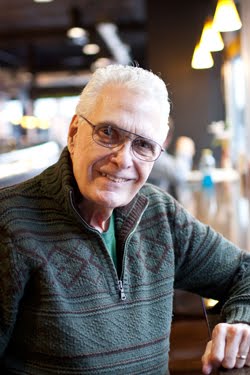
My grandfather died of Lou Gehrig’s disease in 1941, in the same hospital where I was born in 1942. I have always regretted being deprived of knowing him. When I was a child, I spent a week each summer at my grandmother's house. Above the television, hanging on the gold wallpaper, were two oval, mahogany frames protecting two beautiful pictures. The picture on the right displayed a lovely young woman with long, wavy, jet-black hair—my grandmother. The picture on the left was my grandfather, a man with a soft, pleasant round face, a receding hairline, and a partial smile.
My grandmother never talked about my grandfather that I recall. As I grew older, I learned a few things about him, but nothing that really told me who he was. I never understood this. Perhaps it was because I never asked questions in spite of my interest. I’ve always been aware of the emptiness of not having a grandfather. My grandmother passed away when I was sixteen. Little did I know that any hope of discovering substantive information about my grandfather died with her.
As I grew older, I would ask my mother and her siblings about him, but no one seemed to know much about his past, and what they did remember conflicted with each other’s memories. Together my grandparents spoke nine languages. They wanted their children to be Americans; so when they spoke of the old countries, they spoke in a language their children didn't understand. She was from Poland, and he was from Russia.
None of their sons had children, therefore, my grandfather's name did not continue. He seemed like a ghost. All of their children, three sons and three daughters, have passed away except my Aunt Sarah. After my mother passed away, I sat down with my aunt and asked her every question I could think of, gleaning every detail I could. I then began to research the history of the time of my grandparent’s immigration to the United States. I found pieces of information that made the bits of truth I had already learned make sense. He had been a Russian Cossack soldier in the Ukraine, immigrating to America in 1910.
Writing this story has pushed my imagination to the limit. I wonder what my life might be like had my grandparents not come to America. Would my grandmother have been a victim of Hitler’s furnaces like the majority of her family? Would my grandparents still have met and married? Would I be a Polish or Ukrainian citizen—or an immigrant? Let me introduce you to my grandfather as I imagine him.

As the story began to take shape, I found I was writing it for my heirs. I wanted them to have a heritage, too.
Sometime during the process, I shared it with a published writer on a Yahoo writers group. She said I was on to something so I joined a local critique group. They agreed and encouraged me to pursue publication. Before I had finished the manuscript, a friend and his wife asked me to help them set up a website. They were starting a publishing company. In the process, they discovered the first chapter of my novel on my own site and asked to read the manuscript. When they finished, they asked me if they could publish the book.
Now I speak to young adults in schools, homeschool groups, and clubs. I encourage them to find out all they can about their ancestors before it is too late, but I have found that their parents take an interest as well.
After researching and studying the history of the Jews in the late 19th and early 20th centuries, I understand the fear my grandparents lived with and suppressed. They were terrified that Hitler was going to make it to America. They wanted their children to be Americans. I know they didn’t realize they were robbing their heirs of our heritage.
My novel is a great story for any age although I wrote it for the YA genre. I have received letters from readers age twelve to eighty-six expressing appreciation of my novel. Another author, who is a retired schoolteacher, reviewed my book and then wrote a ten-day study guide so homeschoolers, families, and book clubs could get the most from my story. I am humbled and grateful for this, but the greatest blessing is the closure I have received and, although he is mostly fiction, I have a grandfather.