Showing posts with label English history. Show all posts

Wednesday, March 14, 2018

Wandering Wednesday: Bath, England

By Carolyn Miller @CarolynMAuthor


As a major fan of Jane Austen and Georgette Heyer, it was inevitable that on a trip to England to visit my sister that I would have to visit Bath, in Somerset. No longer would I have to be the ‘poor relation’ looking on with envy as others posted their scenic shots of places I was meant to be, places I knew so well from such novels as Persuasion, Northanger Abbey, Bath Tangle and a more recent Christian novel Prelude to a Lord. Now it was my turn to walk the streets (not run, as Anne Elliot did in the 2007 film of Persuasion!) and soak up the atmosphere of a city founded by the Romans in the first century AD.

Unsurprisingly for a city named Bath there are…Roman Baths. This iconic bathing complex is based on hot springs, and is a must visit for any tourist. According to UNESCO, the Temple of Sulis Minerva and the baths are some of the most important Roman remains north of the Alps, with the associated waters considered to hold health-giving properties, which led to it becoming England’s premier Spa town of the Georgian period.

Today, you can visit the Baths, see the Roman remains, or, if you’re like me with something of an Austen addiction, ‘take the waters’ at the Pump Room, where the famous pump delivers the slightly sour tasting water for your improved health, and where numbers of characters of various books have visited. Of course, I had to take my characters there in my new Regency novel Winning Miss Winthrop, both to experience the waters and the gossip associated with this fashionable venue of the 1800s.
Nearby is the magnificent Bath Abbey, founded in the 7th Century as a Benedictine monastery, which owes a lot of its current splendour to major restoration work in the mid-1800s. This Grade 1 listed building is a wonderful example of Gothic architecture, and is noted for its breath-taking fan vaulting and stained glass. Definitely worth a visit.


Of course, a trip to Bath means a visit to the Jane Austen centre, where one can learn more about this illustrious author, take a tour, try on Regency attire, and even take tea with Mr. Darcy (!). This is a fabulous place to conduct research, such as examining Regency-era concert programs, complete with descriptions of Galas of music and Grand Illuminations (fireworks) of new devices and decorations - in other words, a Regency author's dream.
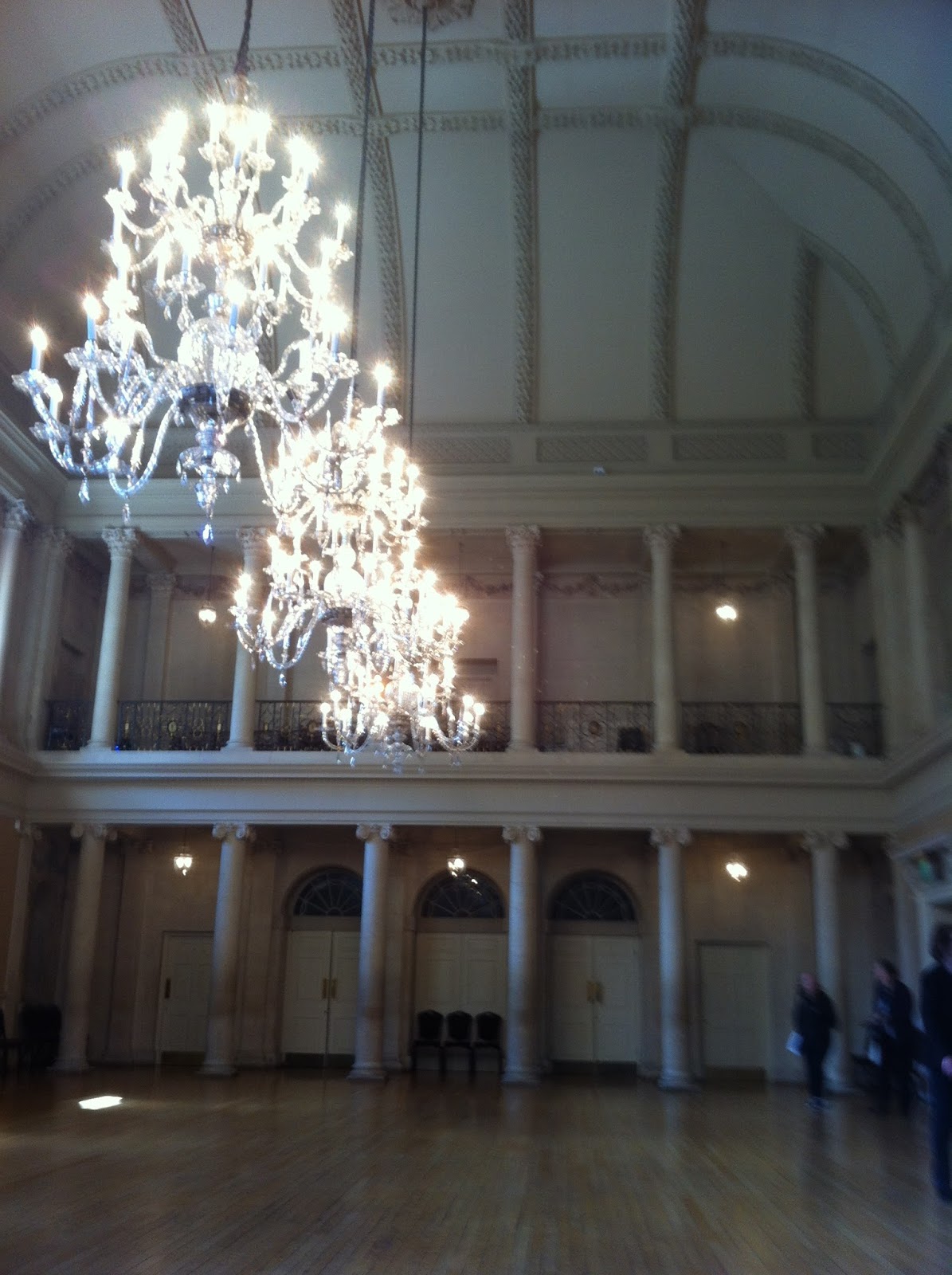


Walking up Gay Street takes you past a glory of Georgian architecture, before The Circus (a street enclosing a round park) takes us to the Upper Assembly Rooms, where elegant society would assemble and mingle and perhaps engage in matchmaking. These rooms consist of the Ballroom, Octagonal room, tea rooms, and card rooms, and were the site of dances, concerts and lectures, and the site of many dramatic scenes for Austen heroines. I used these elegant 18th Century rooms for a number of pivotal scenes for Miss Winthrop – including a masquerade!


Not far away is another of the iconic scenes of Bath – the Royal Crescent, a row of 30 terraced houses in a semicircle, and one of the most fabulous examples of Georgian architecture in Britain, and a prestige address with its views over the park opposite.


Bath is built in the valley of the River Avon, with many steep streets and rows of terraced houses lining the surrounding hills, all designed for aesthetic appeal by illustrious 18th century builders. A walk along the river takes you across the beautiful Pulteney bridge and up another hill to Sydney Gardens. This is another location mentioned in Austen and Heyer novels, and a place any true Austen aficionado should visit – and Austen-inspired authors should use. So, of course I had to set several scenes here, especially as the many trees and paths make it perfect for secret rendezvous.

Bath is well worth a visit even if you’re not a history buff or a great fan of Austen’s literature. It is one place (of many!) I’d love to return to, and spend longer time, soaking in the atmosphere of this beautiful, evocative city.

Giveaway


Carolyn Miller is giving away an print copy or ebook copy (winner's choice) of Winning Miss Winthrop. To enter the giveaway, please leave a comment on this post and/or ICFW's March New Releases post on March 19. Receive two entries in the drawing by commenting on both posts. I'll draw a winner from the comments on Saturday, March 24.  

Carolyn Miller lives in the beautiful Southern Highlands of New South Wales, Australia, with her husband and four children. Together with her husband she has pastored a church for ten years, and worked part-time as a public high school English and Learning and Support teacher. A longtime lover of romance, especially that of Jane Austen and Georgette Heyer’s Regency era, Carolyn holds a BA in English Literature, and loves drawing readers into fictional worlds that show the truth of God’s grace in our lives. Her Regency novels include The Elusive Miss Ellison, The Captivating Lady Charlotte, and The Dishonorable Miss DeLancey, all available from Amazon, Book Depository, Koorong, etc 

Connect with her: website | facebook | pinterest | twitter

Thursday, July 5, 2012

GLASTONBURY, The Story of My Life

I’ve been known to say, and I don’t think it’s too much of an exaggeration, that GLASTONBURY, A Novel of The Holy Grail, is the book I was born to write.

Just as the search for the Holy Grail is the centerpiece of this 820-page novel covering 1500 years of English history, so the stories of King Arthur have been a centering passion for my life. I wrote my first short story when I was about ten years old: Sir Lancelot killed the dragon and rescued the maiden from the tower. Of course I was convinced it was brilliant, but I was worried because I knew every other child would have written the same story. It was, after all, simply the only story there was to tell. Imagine my surprise to find I was the only Arthurian scholar in the fourth grade.

As an English major in college I loved "Sir Gawain and the Green Knight," "Idyls of the King" and all the others in the repertoire. As a mother I saw to it that my three sons had castles to play with and knights costumes to dress up in (along with Batman, Superman and Flash Gordon, of course). And when they grew up I was several times asked by their English teachers to talk to their classes when they were studying the Arthurian legends.

The thing that really brought it all to life for me, though, was a research trip I made to the west country of England in the early 1980’s. My editor at that time accompanied me on the trip because we were both working on books set in Monmouth in Wales. Of course I couldn’t be that close to Glastonbury without making pilgrimage to the Holy Isle of Avalon.

After our all-too-short two day stay, we were leaving town when Carole began reading aloud from a little blue pamphlet she had picked up at a bookstall: "‘Did our Lord ever come to Glastonbury as a lad? The story lingers not only here, but elsewhere as well. Briefly, the tradition is that the young Jesus, entrusted to the care of his Uncle Joseph of Arimathea by his mother Mary, daughter of Joseph's elder brother, accompanied Joseph on one of his expeditions to Britain to seek metals for his flourishing trading company.’"

I gave a shout of laughter. "What? That's crazy!"

But Carole kept on. "No, wait, this is interesting. It says, ‘Perhaps there is some truth in the tradition which still lingers in Somerset that St. Joseph of Arimathea came to Britain first as a metal merchant seeking tin from the Scilly Isles and Cornwall, and lead, copper, and other metals from the hills of Somerset, and that his nephew came with him as a boy. The tradition is so startling that the first impulse is to reject it summarily as ridiculous.’"\

"It sure is," I said, but Carole kept on.

"‘Amongst the old tin-workers, who always observed a certain mystery in their rites, there was regularly a moment when they interrupted their work to sing a quaint song beginning, "Joseph was in the tin trade."
If this is so, it is quite natural to believe that after the crucifixion, when the church was dispersing under persecution and in answer to the Great Commission, Joseph and his party, which included his son Josephes, would come to this land with which Joseph was already acquainted.

"‘Among the cherished possessions the little band brought with them was the cup used at the Last Supper in Joseph of Arimathea's Jerusalem residence, an ordinary cup in everyday use in his house, now become a sacred treasure, since with this cup of olivewood our Lord had inaugurated the new covenant.’"
Now my imagination soared and I wasn't laughing at all.

In 1987 I had proposed to write the Glastonbury Series— six novels covering Celtic, Roman, Arthurian, Anglo-Saxon, Norman and Tudor England. After I sent off the proposal I read Edward Rutherfurd’s SARUM and realized how well my proposed series would fit a similar format as a single novel.

When Jan Dennis, acquisitions editor at Crossway, called me early on the morning of the Fourth of July (writers and editors seldom vacation) I said, "Wait, I’ve had a better idea." Jan had just read SARUM as well and wanted to publish a novel like that.

In 1992 the first edition of GLASTONBURY, The Novel of Christian England, was published by Crossway Books with its cover showing the broken arches of Glastonbury Abbey through a bower of leafy green.


And then in 2000 GLASTONBURY was brought back in a fully reedited edition with a beautiful black cover bordered with Celtic knotwork.

And now, after 20 years in print, GLASTONBURY, The Novel of the Holy Grail, has a whole new life with yet another stunning cover in a version fully reedited for ebooks. http://ning.it/NZ66gO

And so the saga continues. My new publisher uses the strapline: The Holy Grail lies somewhere in Glastonbury!

And I reply, "So does my heart."


Donna Fletcher Crow is the author of 40 books, mostly novels dealing with British history. The award-winning Glastonbury, A Novel of the Holy Grail, an Arthurian grail search epic covering 15 centuries of English history, is her best-known work. Donna and her husband live in Boise, Idaho. They have 4 adult children and 11 grandchildren. She is an enthusiastic gardener.

Donna is also the author of The Monastery Murders: A Very Private Grave and A Darkly Hidden Truth, as well as the Lord Danvers series of Victorian true-crime novels and the romantic suspense series The Elizabeth & Richard Mysteries. To read more about all of Donna’s books and see pictures from Donna’s garden and research trips go to: www.DonnaFletcherCrow.com.