Showing posts with label English Regency. Show all posts

Wednesday, July 25, 2018

Wandering Wednesday: Derbyshire and Pemberley!

by Carolyn Miller @CarolynMAuthor


My brand new Regency novel, Miss Serena's Secret, is set partly in Derbyshire, so to celebrate, I thought it would be nice to take a visit to two of the iconic houses in this area, both of which have been used in filmed versions of one of my all time favourite novels, Jane Austen's Pride and Prejudice.
Chatsworth House, Carolyn Miller Author

Chatsworth House

Chatsworth House is the ancestral home of the Dukes of Devonshire, and has been in the Cavendish family's possession for sixteen generations! This Baroque styled house was used as the setting for Mr Darcy's Pemberley in the 2005 film of Pride and Prejudice starring Keira Knightley.
A grand staircase takes you up to the first of the State rooms.
Chatsworth House, Carolyn Miller Author

Chatsworth has often been voted one of England's favourite stately homes, and it's not hard to see why. Visitors are allowed to take pictures (!), and there is so much to see in a history-filled house of such wealth and importance. The Chapel remains virtually unaltered since it was built between 1688 and 1693. Its altarpiece of alabaster and marble is stunning, and a reminder of the importance faith held for families, when they would gather for daily prayers and Sunday worship.
Chatsworth House, Carolyn Miller Author
I wanted to show the awe of my artistic heroine (Miss Serena) as she visited a place such as this, and viewed the magnificence of the sculptures and paintings, such as those that line so many of the walls at Chatsworth. Here are some pictures I took of some of the magnificent artwork of Chatsworth, including the Sculpture Gallery from that famous scene in P&P!
Chatsworth House, Carolyn Miller Author

Chatsworth House, Carolyn Miller Author

Places like Chatsworth were designed to make a statement about a family's wealth and social position. This can be seen in the State and Guest bedrooms, where magnificence abounds in the furnishings, fabric and absolute attention to detail. 
Chatsworth House, Carolyn Miller Author

Chatsworth House, Carolyn Miller Author


Imagine being brought up in such a setting! Imagine visiting, as the far more humble daughter of a far more humble background, and being asked to dine at a table not unlike this!
Chatsworth House, Carolyn Miller Regency Author
One of the things I enjoyed about Chatsworth (there were so many!) was the inclusion of collectibles by the family, things that make a house more a home. The 5th Duchess of Devonshire collected minerals, and I included references to the local stone known as 'Blue John' in Miss Serena's Secret.
Chatsworth House, Carolyn Miller Regency Author


Of course, one can't visit Chatsworth without enjoying its magnificent gardens, with famous features such as the Cascades, designed to feed the Sea Horse fountain in the south lawn.
Chatsworth House, Carolyn Miller Author

Chatsworth House, Carolyn Miller Author
So much magnificence! So little time - especially if one still wants to visit the other (real!) Pemberley of Lyme Park, located not too far away in nearby Cheshire. 

Lyme Park

The exterior of this stately home was used in the 1995 BBC production of Pride and Prejudice starring Colin Firth, and holds special significance because my husband worked here in its garden in the 1990s!
So here's some pics I took with my sister of the gardens and courtyard of this very stately building.

Lyme Park, Carolyn Miller Christian Regency Author

Lyme Park, Carolyn Miller Christian Regency Author

Lyme Park, Carolyn Miller Christian Regency Author

Lyme Park, Carolyn Miller Christian Regency Author

Visiting houses like these are such rare occasions for this Aussie from the opposite side of the world that one has to make the most of it via so many pictures and mementoes. For more pictures visit my website www.carolynmillerauthor.com and check out the Miss Serena's Secret page.

Want to know more about the book? Here's the blurb:
Scarred by her past, Serena Winthrop is determined to protect her heart - especially from flirts like the too smooth Viscount Carmichael. But when forced to share his roof, she discovers another side to the man who gambles with women's hearts as he does their husband's money. 
​
Henry, Lord Carmichael, struggles with the weight of his Derbyshire's family's expectations, until he finds a hope shared by the too perceptive, too young artist. But he's promised to protect his best friend's innocent sister-in-law, not charm her, much to his - and her - private dismay. 
​
When her art leads her to London infamy, he's forced to choose between the life mapped out for him, and the love of his life, with whom marriage might prove the end of his family line. 

You can purchase copies here.

Giveaway!

To celebrate the launch of Miss Serena's Secret I have one e-copy to give away, anywhere in the world. For your chance to win, leave a comment on this blog post, and to double your chances, leave a comment on the International Christian Fiction Writers July 2018 New Releases post. Entries close 31st July.

Carolyn Miller lives in the beautiful Southern Highlands of New South Wales, Australia, with her husband and four children. Together with her husband she has pastored a church for ten years, and worked part-time as a public high school English and Learning and Support teacher. 
A longtime lover of romance, especially that of Jane Austen and Georgette Heyer’s Regency era, Carolyn holds a BA in English Literature, and loves drawing readers into fictional worlds that show the truth of God’s grace in our lives. Her Regency novels include The Elusive Miss Ellison, The Captivating Lady Charlotte, The Dishonorable Miss DeLancey, Winning Miss Winthrop and Miss Serena's Secret, all available from Amazon, Book Depository, Koorong, etc

Connect with her:        website | facebook | pinterest | twitter | instagram

Wednesday, March 14, 2018

Wandering Wednesday: Bath, England

By Carolyn Miller @CarolynMAuthor


As a major fan of Jane Austen and Georgette Heyer, it was inevitable that on a trip to England to visit my sister that I would have to visit Bath, in Somerset. No longer would I have to be the ‘poor relation’ looking on with envy as others posted their scenic shots of places I was meant to be, places I knew so well from such novels as Persuasion, Northanger Abbey, Bath Tangle and a more recent Christian novel Prelude to a Lord. Now it was my turn to walk the streets (not run, as Anne Elliot did in the 2007 film of Persuasion!) and soak up the atmosphere of a city founded by the Romans in the first century AD.

Unsurprisingly for a city named Bath there are…Roman Baths. This iconic bathing complex is based on hot springs, and is a must visit for any tourist. According to UNESCO, the Temple of Sulis Minerva and the baths are some of the most important Roman remains north of the Alps, with the associated waters considered to hold health-giving properties, which led to it becoming England’s premier Spa town of the Georgian period.

Today, you can visit the Baths, see the Roman remains, or, if you’re like me with something of an Austen addiction, ‘take the waters’ at the Pump Room, where the famous pump delivers the slightly sour tasting water for your improved health, and where numbers of characters of various books have visited. Of course, I had to take my characters there in my new Regency novel Winning Miss Winthrop, both to experience the waters and the gossip associated with this fashionable venue of the 1800s.
Nearby is the magnificent Bath Abbey, founded in the 7th Century as a Benedictine monastery, which owes a lot of its current splendour to major restoration work in the mid-1800s. This Grade 1 listed building is a wonderful example of Gothic architecture, and is noted for its breath-taking fan vaulting and stained glass. Definitely worth a visit.


Of course, a trip to Bath means a visit to the Jane Austen centre, where one can learn more about this illustrious author, take a tour, try on Regency attire, and even take tea with Mr. Darcy (!). This is a fabulous place to conduct research, such as examining Regency-era concert programs, complete with descriptions of Galas of music and Grand Illuminations (fireworks) of new devices and decorations - in other words, a Regency author's dream.


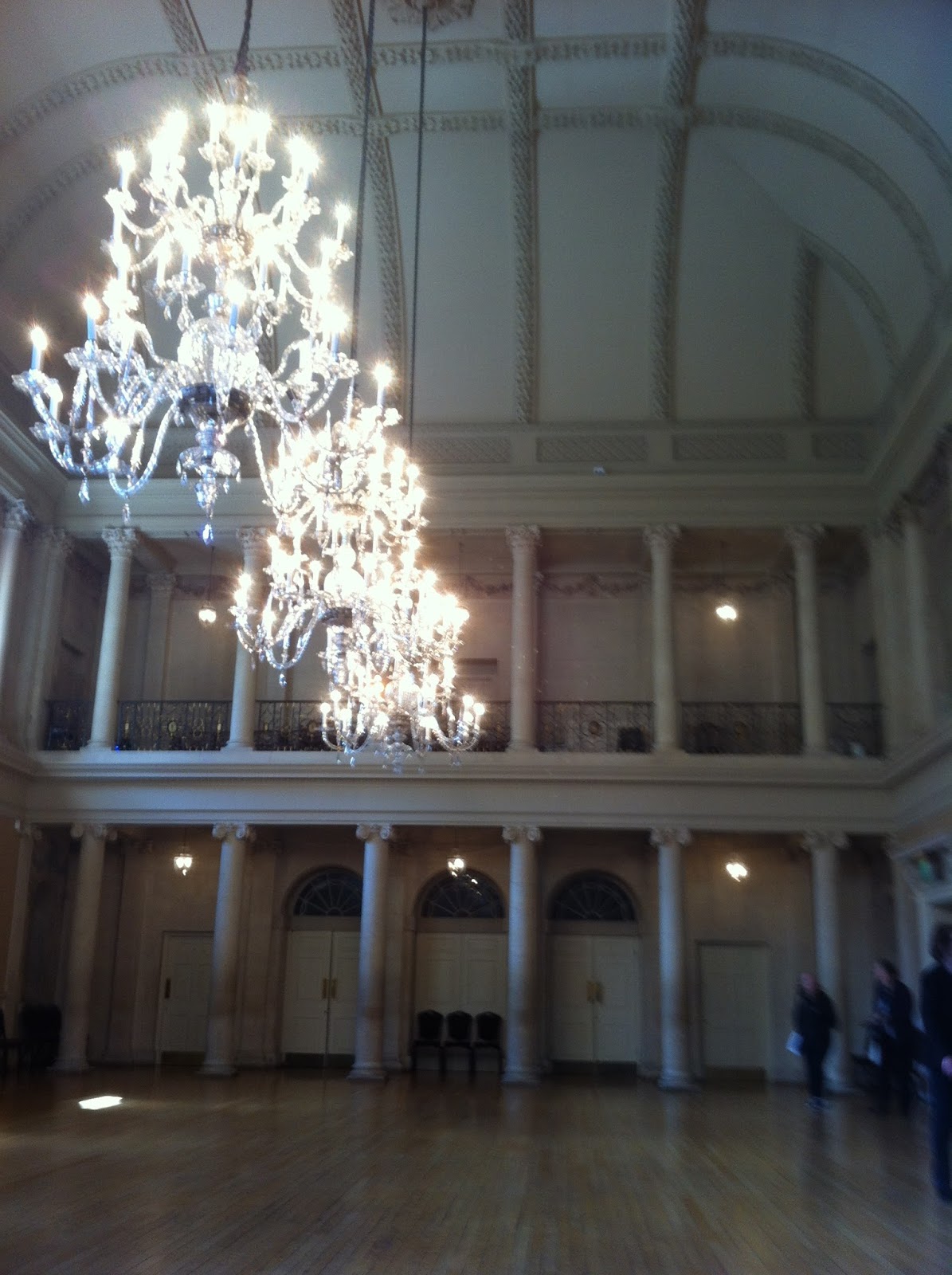
Walking up Gay Street takes you past a glory of Georgian architecture, before The Circus (a street enclosing a round park) takes us to the Upper Assembly Rooms, where elegant society would assemble and mingle and perhaps engage in matchmaking. These rooms consist of the Ballroom, Octagonal room, tea rooms, and card rooms, and were the site of dances, concerts and lectures, and the site of many dramatic scenes for Austen heroines. I used these elegant 18th Century rooms for a number of pivotal scenes for Miss Winthrop – including a masquerade!


Not far away is another of the iconic scenes of Bath – the Royal Crescent, a row of 30 terraced houses in a semicircle, and one of the most fabulous examples of Georgian architecture in Britain, and a prestige address with its views over the park opposite.


Bath is built in the valley of the River Avon, with many steep streets and rows of terraced houses lining the surrounding hills, all designed for aesthetic appeal by illustrious 18th century builders. A walk along the river takes you across the beautiful Pulteney bridge and up another hill to Sydney Gardens. This is another location mentioned in Austen and Heyer novels, and a place any true Austen aficionado should visit – and Austen-inspired authors should use. So, of course I had to set several scenes here, especially as the many trees and paths make it perfect for secret rendezvous.

Bath is well worth a visit even if you’re not a history buff or a great fan of Austen’s literature. It is one place (of many!) I’d love to return to, and spend longer time, soaking in the atmosphere of this beautiful, evocative city.

Giveaway


Carolyn Miller is giving away an print copy or ebook copy (winner's choice) of Winning Miss Winthrop. To enter the giveaway, please leave a comment on this post and/or ICFW's March New Releases post on March 19. Receive two entries in the drawing by commenting on both posts. I'll draw a winner from the comments on Saturday, March 24.  

Carolyn Miller lives in the beautiful Southern Highlands of New South Wales, Australia, with her husband and four children. Together with her husband she has pastored a church for ten years, and worked part-time as a public high school English and Learning and Support teacher. A longtime lover of romance, especially that of Jane Austen and Georgette Heyer’s Regency era, Carolyn holds a BA in English Literature, and loves drawing readers into fictional worlds that show the truth of God’s grace in our lives. Her Regency novels include The Elusive Miss Ellison, The Captivating Lady Charlotte, and The Dishonorable Miss DeLancey, all available from Amazon, Book Depository, Koorong, etc 

Connect with her: website | facebook | pinterest | twitter

Tuesday, July 15, 2014

"Ode to Jane"

Author Julie Klassen is with us today. In her Christy award winning novel, The Girl in the Gatehouse, set during the English Regency, Julie opens a world foreign to the twenty-first century. It’s a world where a girl can be ruined and abandoned by her family for an “indiscretion” while the boy experiences little more than momentary embarrassment. It’s a world where novel authors are held in low repute. (Even the beloved books of Jane Austen were published anonymously in her time.) In this story, several characters are “outed” in this notorious profession. In places the author mimics the style and melodrama of the period, all in good fun.

LeAnne Hardy: Thank you for being with us, Julie. Won't you tell us a little more about the book.

Julie Klassen:  The Girl in the Gatehouse is about a young woman who has been sent away from her home after a scandal. She lives in an abandoned gatehouse on a distant relative’s estate, where she supports herself and her loyal servant by writing novels in secret. Her plan to live quietly goes astray when a wealthy and ambitious naval captain leases the estate. Captain Bryant is intrigued by the beautiful girl in the gatehouse. But he fights the attraction, not wanting to risk his own plans for a woman shadowed by scandal

LH: This book is so much fun. Where did the idea come from?

JK: The spark of the idea came from one of Jane Austen’s minor characters—Maria Bertram, who is caught in immorality and banished by her family to “an establishment being formed for them in another country—remote and private.” Of course in Mansfield Park, we do not admire vain and adulterous Maria Bertram and most readers likely feel she earned her just deserts. But I found myself wondering, What if Maria (pronounced “Mariah” in England) were a character we actually cared about? Would we be content to leave her in her lonely exile? As someone who has made her share of mistakes in life, I am thankful for forgiveness and second chances. And I enjoyed giving Mariah Aubrey hers as well.

LH: I think we are all grateful for second chances. The Girl in the Gatehouse has a delightful Jane Austen feel to it. What do you like best about Austen’s novels?

JK: Thank you. I call this book my “Ode to Jane” and Austen fans will recognize her influence in several aspects of the book. I like Austen’s strong, noble heroes, like Mr. Darcy, Captain Wentworth, Colonel Brandon, and Mr. Knightley. I also enjoy her sense of humor, and the chivalry and manners of the era—where a look across the ballroom or the mere touch of gloved hands sparked romance.

LH: You have even been to a conference of the Jane Austen Society, haven't you? What did you enjoy most about that experience?

JK: Yes, I attended the annual conference for the first time in September 2013. I enjoyed meeting fellow Austen fans from around the world, and learning more about the time period in which Jane Austen lived. I especially loved taking English Country Dance lessons and dancing at the formal ball in my Regency-era gown. 

Julie (center) with friends at the Jane Austen Society ball
LH: Have you visited places like the manor house, gatehouse and poorhouse you describe? What was that like?

JK: I loosely based the fictional manor in the book on one in Lower Slaughter—probably our favorite Cotswold village. I have also been inside a gatehouse, but not the one shown on the cover. And no, I have not been to a poorhouse, but I did manage to find a fair amount of information and old photographs online, which helped me imagine what an institution of this kind might have been like. I have been to England three times now—but at the time I wrote this novel I believe I had only been once. In general, my research is primarily done online and through books—though I find research on location very helpful and try to do so as often as I can. I love visiting England!


Julie outside the gatehouse at Lanhydrock House in Cornwall

LH: Me too. My husband and I spent a wedding anniversary at Lords of the Manor, a short walk up the river from Lower Slaughter, while we were living in England. Gorgeous area! What else do you find valuable for research?

JK: I like old books, maps, diaries, newspapers, advertisements, village web sites, classes through the Jane Austen Society, friendships with fellow Regency authors, etc. There’s always more to learn!

LH: More to learn. That’s what makes writing so much fun, I think. You were already in publishing before you became an author. Tell us a little about your journey.

JK: Like my main character, I was a “secret” or “closet” author for years while I worked as a fiction editor for Bethany House Publishers. I learned so much working with other editors and authors. When I finally completed my first historical, my boss wisely sent it around to my co-workers under a pseudonym so it would be reviewed objectively. Thankfully, they wanted to publish it. After that, everyone knew it was me and I was edited just as hard as I ever edited anyone else!

LH: I loved that not only was the main character a secret author, but several other characters turn out to be hiding similar secrets. How differently was writing viewed as a career in the early 19th c?

JK: Novel-writing in particular was not considered proper or respectable, especially for ladies. Many authors (female and male alike) published anonymously or under pseudonyms in the eighteenth and nineteenth centuries. As you mentioned, Jane Austen’s name never appeared in her novels during her lifetime. The title pages were printed with “by a lady” or “by the author of” one of her previous novels. Thankfully, times have changed.

LH: What should we be looking forward to from the pen of Jane, I mean, Julie Klassen?

JK: My 8th Regency era novel, The Secret of Pembrooke Park, is due out from Bethany House in November of this year. It centers around a long-abandoned manor house and is filled with mystery, family drama, and romance. I hope you’ll enjoy it!

LH: I’m sure we will. I love mystery around long-abandoned places! Readers, as Julie mentioned, this will be her eighth Regency novel. So if you go to your favourite on-line book site, you will find lots to interest you between now and November. Julie, thank you for being with us today.


___

LeAnne Hardy, author of the Glastonbury Grail series, has lived in six countries on four continents. She first met Julie Klassen at a book signing and has been a fan ever since. LeAnne's fiction reflects her faith, her passion for storytelling that stretches the mind and soul, and the cultures she has lived in. Learn more on her website.