Showing posts with label Jeanette Windle. Show all posts

Thursday, July 28, 2016

Time Out...for Reading

by Janice L. Dick

It’s summertime here in Canada, and thoughts of summer bring to mind pictures of people lounging in the sun, reading. I read all the time for many reasons, but sometimes I like to give myself the gift of reading guilt-free, just for fun. After all, reading has always been my most enjoyable non-writing activity.

Looking back to my youth, I loved the Nancy Drew series. Two main genres that most intrigued me at that time were mysteries and horse stories. (I was fortunate to live on a farm with horses, so that was a dream come true.)

In high school, I discovered classic novels, including Russian titles such as Anna Karenina, War and Peace, Crime and Punishment, The Brothers Karamazov (didn’t ever get through that last one).

When my children were young, I couldn’t find as much time to read, settling for short books on how to keep your sanity while parenting young children. And children’s books, of course.

Then I discovered Bodie Thoene. She was the author who inspired me to venture into writing. I found her books bold and intense and impressive, and wanted to write like her. (I’ve since realized that no matter what books and writers I admire and emulate, I still must find my own voice and style.)

My current interests vary widely. I have always loved historical fiction, and I should, since that’s primarily what I write, but I also enjoy good contemporary fiction. I’m on the library committee at our church, so I get to read lots of different Christian authors: Jeanette Windle, Joel C. RosenbergHeather Day GilbertPatrick W. CarrTerri Blackstock, James Scott BellAngela HuntJill Eileen SmithDani PettreyDee HendersonSiri Mitchell, to mention a few.

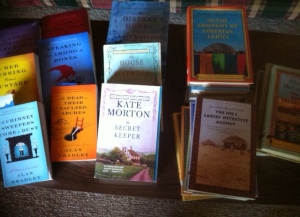
photoMy preferred secular books are Alexander McCall Smith’s The Ladies No. 1 Detective Agency series, Alan Bradley’s Flavia deLuce series, and Kate Morton’s novels. I also stumbled upon Lorena McCourtney’s Ivy Malone cozy mysteries, which I love. Add to that my complete series of The Cat Who books by Lilian Jackson Braun, which I’ve read and re-read for easy, engaging entertainment.

I could go on, but I’d love to know what some of your favourite titles are. What do you read just for fun?

Monday, February 9, 2015

Real and Imagined Dystopias

Even if you haven’t read The Hunger Games, you probably saw the movie or at least heard all the hype about it: teens from the different regions of a future North America are drawn from a lottery to be sent to compete in a reality TV series where they kill each other and the last one alive wins. It’s a fascinating book about the horrors of violence and the gifts of compassion and cooperation. That is book 1. I found book 2 (Catching Fire) needed to augment the violence the author purported to despise in order to hold its audience. Book 3 (Mockingjay) is a cynical twist on just war that ends with hope that cannot be justified apart from the gospel.

The series is part of a popular trend in YA literature—the dystopian novel. Dystopia is the opposite of Utopia (meaning “no place” in Greek). It’s the name Sir Thomas More gave to the idealized community he wrote about in the sixteenth century. Instead of the perfect society imagined by More, a dystopia is a totally dysfunctional society, a horror story where the monsters are human.

I have recently been reading two dystopian series (alternating as my name comes up for the next book on library holds.) The first is the Last Survivors series by Susan Beth Pfeffer, beginning with Life as We Knew It. An asteroid hits the moon, setting off a series of environmental disasters and the collapse of modern civilization. It begins as a pretty ditsy teen novel, which actual provides a strong sense of this-could-happen-to-me to the survival story that follows. It’s enough to make you appreciate a bottle of shampoo and a tin of string beans.

In The Maze Runner series by James Dashner (beginning with The Maze Runner) we are thrust into the dystopian world from page one. I’m on book 3 and still have no idea what is behind it all except that this is some kind of scientific experiment designed to save humanity from a disaster even worse than what the teens trapped in the maze are experiencing. Sounds wacko, as it does to the characters, but the action will definitely keep you reading.

In each of these series, I am completely hooked by book 1. Unlike certain vampire books that were recently the rage, the writing is excellent. But the more I read, the more I find myself thinking, what’s the point? I have never been a fan of horror movies. There is enough really bad stuff in reality. Why do I need to be scared by imaginary axe murderers and walking mummies? (You can tell what generation I come from.)

Can you imagine a society more dystopian that ISIL? Or how about North Korea where starving people are told they are so much better off than the rest of the world? Authors on this blog have written about real dystopias. I think of Kathi Macias's Red Ink or Jeannette Windle’s series on Afghanistan beginning with Unveiled Freedom. Jeanette has other books involving drug cartels that control whole regions of countries.

For me a dystopian novel needs to be more than a series of graphic events that chill and horrify in a society without hope of justice. It needs to show me something about myself or reveal realities that should be on my prayer list (like China or Afghanistan). I admit, that I have had a dystopian idea in my head for several years now. I ask myself, what would be the point?


What dystopian fiction have you read? What made it worthwhile for you? We can expand the conversation to horror if you like. What makes a book like Dracula or Carrie worth reading? Or are they? How would the gospel change The Hunger Games or other dystopian fiction you have read?


___


LeAnne Hardy has lived in six countries on four continents, including two civil wars, a military government and an emerging democracy. Along the way she has been challenged to depend on God rather than the American constitution. Her fiction reflects her faith, her passion for storytelling that stretches the mind and soul, and the cultures she has lived in. Learn more at www.leannehardy.net .

Thursday, January 24, 2013

Interview with Jeanette Windle and Congo Dawn book giveaway


Narelle here. I'm delighted to have the pleasure of interviewing ICFW member Jeanette Windle today on our blog. We are also giving away a copy of Jeanette's brand new release, Congo Dawn.


As daughter of missionary parents, award-winning author and journalist JEANETTE WINDLE grew up in the rural villages, jungles, and mountains of Colombia, now guerrilla hot zones. Her detailed research and writing is so realistic that it has prompted government agencies to question her to determine if she has received classified information. Currently based in Lancaster, PA, Jeanette has lived in six countries and traveled in more than thirty on five continents. Those experiences have birthed 16 international intrigue titles, including bestselling Tyndale House Publishers release Veiled Freedom, a 2010 ECPA Christian Book Award and Christy Award finalist and sequel Freedom's Stand, a 2012 ECPA Christian Book Award and Carol Award finalist and 2011 Golden Scroll Novel of the Year finalist. Jeanette mentors developing nation writers in both English and Spanish on all five continents.


While former Marine lieutenant Robin Duncan is no stranger to corruption or conspiracy, she has always been able to tell the good guys from the bad, and the Congo jungle at first seems no different. But as her security team tries to track down an insurgent killer, Robin has to face a man who broke her trust years ago, and she discovers the gray areas extend farther in this jungle wilderness than she anticipated.

A ruthless global conspiracy begins to surface, run by powerful men who can’t afford to leave any witnesses. Her life at stake, Robin doesn’t know who to trust and wonders how she can help protect innocent people. Why is God silent amid all the pain and injustice? And how do these people of faith continue to rejoice in their suffering?

Narelle: What was your inspiration for writing Congo Dawn?

Jeanette: Growing up in the world's largest rainforest, the Amazon, I was captivated by missionary biographies from its second-largest African counterpart, the Congo. Among them the story of Dr. Helen Roseveare, who helped establish several mission hospitals and medical training centers in the Ituri rainforest despite violence and unrest of impending Congolese independence, herself held captive for five months during the 1964 Simba rebellion. The largest of those centers Nyankunde was in turned razed in 2002 during the continuing conflict that has taken more than five million Congolese lives in the last decade.

Today's fighting is greatly aggravated by the value and pursuit of conflict minerals in that zone. As always, it has been the mission pilots, medical personnel both expatriate and Congolese, and other followers of Yesu, Jesus Christ, who have been first back into the conflict zones well ahead of United Nations, embassy, local law enforcement or any other humanitarian and corporate interests. Their courage in shining bright the light of Yesu's love in one of the planet's darkest corners gave voice to this story.

For the story's actual suspense thread, I've had personal opportunity to witness what a multinational corporation is capable of in dark corners of the Third World when no one is watching (an experience in itself too unbelievable to write up as fiction). In Africa as elsewhere, both the protective and striking arm of such corporations has historically been hired foreign mercenaries. But today's private military corporations are vastly different, possessing more fire power than the average country. What struck me was the lack of any accountability to outside oversight beyond some paid-off local warlord. So what happens when a multinational corporation with unlimited funds hires on a private military company with unbridled power in a Congolese rainforest where the ultimate 'conflict mineral' is up for grabs? Coming up with one very plausible possibility birthed Congo Dawn.

Narelle: I love how you describe the international settings in your books in a way that brings the characters and stories alive on the page. Have you visited Democratic Republic of Congo (DRC)? How did you undertake your research for Congo Dawn?

Jeanette: The Ituri rainforest of eastern Democratic Republic of Congo is actually the first book setting where I haven't spent significant time on the ground. There are two reasons for that. One is that the story of Congo Dawn along with its spiritual theme is one that could be replicated across Africa and the planet, including places I have indeed lived, so that I had many choices where to set it. I chose the Ituri because its own poignant history encapsulates so well the theme of this book and because the Ituri is so similar to my own background setting, growing up in the planet's "other Ituri", the guerrilla zones of the Colombian Amazon rainforest. Not just a similar equatorial jungle landscape with much the same plant and animal life, foods, riverbank villages. But the same history of European colonial conquest, corrupt, oppressive aristocracies, equally unjust and violent rebel insurgencies. The juxtaposition of vast natural resources reaped by powerful international corporations with an impoverished, often starving indigenous population. The same issues of conflict minerals (and drugs) fueling guerrilla insurgencies. The same mix of an imposed nominal Christianity with animistic native religions.

On a more positive note, the same jungle mission communities so familiar to my own childhood offering medical care, education, and the love of Jesus Christ in the midst of difficult and dangerous circumstances. The jungle base featured in Congo Dawn, Taraja (Hope), is actually based on true-life Ituri rainforest medical compound Nyankunde, where famed missionary doctor Helen Roseveare served in the 1960s, destroyed during a rebel massacre in 2002. While attempts continue to reopen Nyankunde, the on-going fighting in the region is another reason I wasn't able to go in personally.

But I was blessed with wonderful "boots on the ground" technical readers and research sources among the intrepid bush pilots and medical personnel who have been the first to go back in as well as native Swahili speakers, Special Ops, third-generation expatriate missionaries who've spent their lives in the Ituri rainforest zone, etc. And of course I researched thoroughly, running each piece of the story back past those same on-the-ground readers for approval before it reached print.

Narelle: Michael and Robin, your hero and heroine in Congo Dawn, have complex backgrounds that provide strong emotional conflict in the story. Please give us an insight into the struggles Michael and Robin face in Congo Dawn.

Jeanette: Michael and Robin both come into the story from backgrounds of loss, sacrifice, grief, not just for themselves but others. A question Robin asks at one of the story's high points perhaps sums up best the struggle both wrestle with: “I would give my own life to stop the pain I’ve seen. To stop little girls and boys from being raped. Or just as bad, forced into armies where they’re turned into killers . . . To keep families from being torn apart by war. Children dying of preventable diseases for lack of a dollar’s worth of medicine . . . So am I more compassionate than the God who created all these people, created all this beauty? There’s the question, and I’ve never yet found anyone who can give me a credible answer. How can an all-powerful God who claims to love humanity look down on our planet and watch such unspeakable things happening, innocent people hurting and dying, bad guys winning over and over again, so much suffering, without it breaking his heart? . . . Without ever reaching down and putting a stop to it?"

It is a heart cry with which I think every reader can identify, and my prayer is that in walking through Robin's own journey, readers will find answers of their own to the core questions of this story. How can a world filled with such darkness, injustice and pain possibly be the creation of a God of love? How can followers of Yesu [Jesus] in the bleakness of an Ituri rainforest conflict zone or any other dark corner of this planet take seriously a Scriptural mandate to rejoice in their suffering [James 1:2; I Peter 4:13]? What value beyond our own comprehension might human suffering possibly hold that a loving Creator God permits it to continue?

Narelle: Congo Dawn explores the roles multi-national corporations may play in developing countries. What difficulties do the local people face when confronted with foreign companies looking to exploit their natural resources?

Jeanette: Human nature--and greed--being what it is, local populations are rarely considered when it comes to developing natural resources, other than as a handy labor source to exploit for extracting them. As far back as the European colonial era or the United Fruit Company in Central America, foreign multinationals developing local resources has too often been a one-way flow of wealth into those foreign coffers, leaving poverty and devastation at a local level in countries that should be prosperous. In the DRC, for instance, rubber, diamonds, gold, oil and numerous other mineral reserves make the Congo one of the most naturally wealthy regions on Earth. But as memorialized in the Joseph Conrad classic 'Heart of Darkness', that wealth spawned one of the most brutal colonial eras ever documented. Once Portuguese explorers discovered the Congo in the 1500s, slave raids and trading decimated its population. Under Belgian colonial rule, millions more died through forced labor and horrific working conditions in rubber plantations and mines. This didn't change of course under the succession of dictators and brutal warlords who replaced foreign colonialists, but now rake in profits hand-in-hand with multinational corporations. Changing that would require that profits from a region's natural resources to be ploughed at least partially back into developing that region (as the Congolese character hoped in Congo Dawn). But for that to happen requires above all a change of attitude and action in those responsible, and that will never happen without the transforming love of Jesus Christ changing human hearts.

Narelle: Robin asks a number of tough spiritual questions relating to injustice and suffering. How has your faith influenced your writing?

Jeanette: Perhaps the most vital way in which my faith influences my writing is that it is always the spiritual struggles, lessons, hope and redemption through which God has brought me that come alive in the pages of my books. If I am madly scribbling away with tears pouring down my cheeks as my characters wrestle through issues birthed out of my own spiritual journey, I've learned by experience those are the very scenes readers will write me about later, sharing how that message impacted their own lives--and how tears streamed down their own faces as they read.

Narelle: Writers are often encouraged to “write what you know”. How have you real life experiences impacted the type of stories you write?

Jeanette: Having lived now in six countries and traveled in more than thirty, including some of the planet’s more difficult corners, I do write about the world I know, a world well outside Western "First World" comfort zones. While everything in my novels is based on actual events and situations in the countries of which I write, not all is necessarily from my own life. A good example: depictions of jungle captivity in my Colombian guerrilla zone novel The DMZ came not from my own experience, but from personal friends who did spend up to years in captivity.

However, one advantage of having traveled in thirty-plus countries on five continents is that I can pull a lot of sights, sounds, smells, and experiences from my own memory banks, whether the taste of Afghanistan's fine dust in the mouth, the moist fragrance of a high mountain cloud forest, or the chittering, cawing, croaking orchestra of an equatorial jungle.

More importantly, the emotional and spiritual threads of my novels and their protagonists have been birthed very definitely from the life journeys through which God has taken me and the spiritual battles and lessons involved.

Narelle: Please share your writing process with us. Are you a plotter or do you write by the “seat of your pants”? Do you write every day?

Jeanette: I tend to write in chunks of time because I am also in full-time ministry, so I may be on the road for a week, a four-day conference, even a month ministry tour, when I am concentrated completely on the event at hand. If I write then, it will be short articles, interviews, ministry communication. On the flip side, as I answer this question, I am getting ready to take my husband to the airport for a ten-day Asia ministry trip, during which I will be completely alone at home. I plan to write morning till night on my newest WIP (Work-In-Progress).

As to process, all of the above. By the time I've researched my next setting (such as the Democratic Republic of Congo), I have a solid idea of the first part of the story, what political and spiritual theme I want to weave through, and I know the ending (an essential because if you don't know the ending, you end up painting yourself into a corner or wasting months of dead-end writing you have to cut). But the middle is rather broad, opening up in detail as I get to that part of the story.

In rough draft, I will take a week or two brainstorming all kinds of speeches, personal feelings and spiritual thoughts, descriptions of places I've been or researched, thoughts, interviews with "boots-on-the-ground" that give authenticity to those characters, ideas I plan to work into the book, even if I don't know the order they will come into the story. Then as I actually write the story, I can go back and pull those nuggets from my files. I also keep a notebook through each book so that if I think of anything, even if it is for a future part of the book, a conversation, thought, etc., I jot it down so I have it when I get to that part of the story.

By the time I’m done, I have a great story with terribly messy prose. But I’m an excellent editor, so I start back at the beginning, rewriting, rearranging, filling in plot holes, etc. Then comes one last polish for actual prose and grammar. At this point, I am always astounded at how well it has all come together.

Narelle: Please tell us about your upcoming releases. Are you planning to set more books in Africa?

Jeanette: I may eventually. But after seven consecutive adult international intrigue titles and a children's international mystery series, I am actually buried currently in a project that is very much outside either of those boxes, more The DaVinci Code meets Michael Crichton's Timeline than anything I've written to date. It is a story that has been bubbling for years, and I am excited about where it is going. But I hope I won't be leaving you in too much suspense if I reserve the details until I am much further along.


Narelle: Jeanette, thanks for your fascinating and insightful answers. I loved Congo Dawn and I'm looking forward to reading your next book.

By commenting on today’s post you can enter the drawing to win a copy of Congo Dawn. A print copy is available for North American mailing addresses, electronic copy for international. The drawing will take place on Friday, February 1 and the winner announced on Sunday, February 3. Please leave an email address [ ] at [ ] dot [ ] where you can be reached.

"Void where prohibited; the odds of winning depend on the number of entrants. Entering the giveaway is considered a confirmation of eligibility on behalf of the enterer in accord with these rules and any pertaining local/federal/international laws."

To learn more about Jeanette Windle and her books, please visit her website. http://www.jeanettewindle.com/


NARELLE ATKINS writes contemporary inspirational romance and lives in Canberra, Australia. She recently sold her debut novel, set in Australia, to Harlequin's Heartsong Presents line. 

She has published Bible Studies on Smashwords and blogs regularly at http://30MinuteBibleStudies.wordpress.com 

Narelle is a co-founder of the Australian Christian Readers Blog Alliance (ACRBA) http://www.acrba.blogspot.com

To learn more about Narelle, please visit her website.

Thursday, June 28, 2012

Investigative Techniques 2.0: Piecing the Puzzle


It was a particularly steamy Miami evening. I'd been invited to a farewell party for a neighbor, a Special Forces sergeant stationed in Miami with the United States Armed Services Southern Command (SouthCom), now reassigned to the ongoing conflict in Iraq. With three international intrigue novels set in Southern Command's Latin America theater of operations, I'd developed a reasonable fan club among SouthCom personnel. Which in turn had spawned advance copy readers and technical advisers all the way up to an intelligence-branch brigadier general still useful in my current research.

The sergeant's wife was the only other female present in this bastion of testosterone, muscled frames, flowing liquor and loud-cracking jokes. When a tall newcomer entered with stride and body language exuding command presence, I didn't need to be told this wasn't just another of the guys. My host waved me over. "Captain So-and-so, this is Jeanette Windle, the author you've been hearing about."

My host then turned to me. "Jeanette, I'd like to introduce my commanding officer. He just got in from two weeks TDY (temporary duty) down south."

Craning my head far back to permit my five foot, one inch frame to look comfortably into a shrewdly penetrating gaze, I commented without the slightest forethought, "So how did you find Saravena?"

You'd have thought I'd been caught red-handed with the original Declaration of Independence. All conversation (and drinking) halted as the commanding officer exploded, a G-rated, sanitized summary of his tirade as follows: "Who let that author woman in here? How could she possibly know where I spent the last two weeks in the eastern guerrilla zones of Colombia? When I find out who's been talking out of turn, heads will roll!"

My host simply grinned. "I told you she knows more about what we're doing down there than we do."

Not the kind of reassurance one likes to hear from the military intelligence assigned to keep one's birth country safe. Since my SouthCom contacts were as tight-lipped a bunch as they were trained to be, I had not picked up any usable intel from them. So how could I know the classified location of a Special Forces temporary duty operation? In actuality, it was simple enough, as I explained to the commanding officer (an explanation he grudgingly accepted, though like Queen Victoria, he was not amused!). Here's how it all came together:

The US military has long had fingers in Latin America's counternarcotics war. But with the post 9/11 Afghanistan and Iraq conflicts, Congress had recently expanded SouthCom's mission to include training Colombian troops in counterterrorism techniques against leftist guerrillas infesting their jungles. Miami TV news coverage had made mention that the expanded operation would be delayed until Colombia could supply an adequately fortified operating base to house American Special Operations troops.

The exact location of said op was classified. However, American intel restrictions couldn't keep local photojournalists in the eastern guerrilla zones of Colombia from capturing on film the newly reinforced walls and sandbag barricades of a small military base outside the jungle town of Saravena, its reconstruction rumored to be paid for by the Americans.

Then came a casual mention in the Miami Herald that SouthCom troops could heading to Colombia within the month, pending approval of the new facility by US Special Forces command. Again no details. However, just a few days later, the front page of eastern Colombia's regional newspaper boasted a large photo of an American military jet disgorging a dozen US soldiers in camouflage fatigues onto the single airstrip of Saravena's tiny airport. The caption underneath proclaimed, "Southern Command officers arrive from Miami to inspect the future home of their soldiers."

SO when a SouthCom Special Forces captain walks in the door a few days later from 'two weeks TDY down south', where else but Saravena, Colombia, is he likely to have been spending his time?

You (like that Special Forces captain) may be asking just why I'd coincidentally been checking out local Spanish newspapers from a Colombian guerrilla stronghold? That is even simpler. I'd spent my adolescence in Saravena, and I just happened to keep a Google alert for any news from the zone.

Which all goes to show that investigation is basically a matter of:

 1) Putting puzzle pieces together.

2) More importantly, being in the right place and time to uncover those particular puzzle pieces.

I've mentioned in previous postings my upbringing as daughter of American missionaries among the jungles, rivers, Andes mountain trails of the Colombian Amazon. If the guerrillas were back then just unorganized, roving bandits, it was an adventurous environment for an expatriate family, far more so for my parents than for their five offspring, to whom it was simply home. As a child, I really did believe "Yanqui, Go Jom" [Yankee Go Home], scrawled on the whitewash of our perimeter wall, was a normal decoration of any expatriate home. I was barely a teenager the first time I was accused of being a CIA agent; my smart-alecky reply that I was still too young to be recruited.

Today virtually every place I lived as a child remains under guerrilla control. Saravena, a small homesteading town in Colombia's eastern plains, was in my teen years a Wild West stereotype of cantinas, unpaved streets, cowboys galloping into town shooting pistols into the air for weekend drinking sprees, and one tiny thatched evangelical church where my father preached. It was in fact the blueprint for the fictional town in The DMZ, my second adult novel set in the Colombian guerrilla zones.

The discover of oil in the region brought in electricity and pavement, followed by bombs and guerrilla attacks that left much of the town in rubble. But I could still recognize in news photos the vegetation-shaded airstrip where my siblings and I would jog. And the dusty playing field and rusted hoops at the tiny military base on the outskirts of town where as teens we squared off at volleyball and basketball with conscripts little older. Are local youth still allowed through those massive new gates and security barriers to play sports with American Special Ops? Somehow I doubt it.

Since Saravena, I've currently lived in six countries and traveled for ministry in more than thirty on five continents. I raised my own expatriate family in Bolivia, one of the world’s top-five most corrupt countries, where I had the dubious pleasure of a front-row seat to the development of one of the planet's first narco-states, which birthed my first adult novel, CrossFire..
If not a typical North American lifestyle—and certainly not always comfortable—it is a lifestyle with which other members of ICFW can identify. I'm sure those members would agree that there is no better training for an investigative writer. I learned to be wary, observant, always looking over my shoulder and asking who, what, when, why. where, and how. Why is that man across the street looking at me? What is he reaching for in the small of his back? How I can get out of this alley without being backed into a no-exit corner?

How many contradictions did that Customs Officer just make? Why is he patting that over-sized pocket on his padded vest? What size of bribe am I supposed to be slipping in there? When did those two armed guards move in on either side of the exit?

Why did that pickup and white Toyota Corolla just pull up on the shoulder of the road? Who is getting out of the pickup and walking toward the Corolla? Why is he reaching into the trunk to pull out that briefcase instead of speaking to the driver? Where are they speeding off to in opposite directions? How can I discreetly duck out of sight before they notice I’m walking by?

In short, sheer nosy curiosity is not only a survival instinct, but the underlying base of any effective investigative technique.

Now, how to go about applying the above to ferreting out your own puzzle pieces and putting them together? In that long ago past when I was regularly contributing to this blog, I actually gave some practical tips on just that. If you're interested, here is the post: CIA 101: Investigative Techniques from the Trenches


Monday, June 6, 2011

FREEDOM'S STAND--A Review by Christine Lindsay

There are books that are entertaining, and those that are important. And then there are books that are wonderfully both. It is no wonder that Freedom’s Stand has been nominated for the Golden Scroll Award. I wish I could give it more stars than the top 5 star rating.

Note: Tyndale is offering a giveaway of Freedom's Stand. So leave a comment with your email address spelled out. This giveaway is limited to only postal addresses within the US and Canada.

Jeanette Windle has woven heart-rending human rights issues with the fast pace of an action and political thriller as well as a tender romance. I don’t know how many times my heart stopped as a prison door clanged shut on Jamil, a former Muslim extremist and suicide bomber, who is now a follower of Isa Masih (Jesus Messiah). The stakes in this story ratchet higher and higher until we are watching a modern-day Daniel in the lion’s den.

I asked Jeanette why she wrote this book, and why this setting?

Jeanette Windle: Freedom's Stand is the sequel to 2010 Christian Book Award and Christy Award finalist, Veiled Freedom, set in contemporary Afghanistan. Motivation for this story was my own frustration, disappointment--and hope!

Like many of you, I had rejoiced despite the ugliness of war in the post-9/11 overthrow of Afghanistan's Taliban, believing it presaged new hope for freedom and peace in that region. But neither freedom nor peace materialized. Instead today's headlines reflect the rising violence, corruption, and despair. The signing of Afghanistan's new constitution, establishing an Islamic republic under sharia law---and paid for with Western coalition dollars and the blood of our soldiers---tolled a death knell for any hope of real democracy.

Yet the many players I've met in this drama have involved themselves for the most part with the best of intentions. The more I came to know the region and love its people, I was left asking, "If with all the aid and arms and good intentions, freedom has not come to Afghanistan, what is the true source of freedom? Can outsiders truly purchase freedom for another culture or people?"

That question birthed Veiled Freedom. True freedom cannot be bestowed on another people through arms or an aid package, but only through individual hearts transformed by coming face to face with Jesus Christ.

The question Freedom's Stand addresses is: once you've found true freedom in Isa Masih, Jesus Christ, how far will love carry you in sharing that freedom with others?

Ironically, the real-life story that most inspired Freedom's Stand had not yet happened when I began writing it, though conditions on the ground in Afghanistan were such I knew it was only a matter of time. By the time Freedom's Stand headed to print, Red Cross therapist and war amputee Sayed Mossa was but one Afghan Isa-follower who had found himself on death row for his faith under the current Karzai regime.

Though back-door deals recently brought about Sayed's release without every addressing the freedom of faith issue, other Isa-followers with less public press remain on death row in Afghanistan. Meanwhile Sayed himself is now exiled from his country as a condemned apostate.

My motivation in writing this sequel to Veiled Freedom was not just to finish the story of Jamil, Amy, and Steve, but to raise a voice for my brothers and sisters in Christ behind bars or suffering unjust persecution for their faith, not only in Afghanistan but across this planet.

Christine here again: I've been a fan of Jeanette Windle for a long time now, and this latest novel of hers affirms that. www.christinelindsay.com