Showing posts with label Facebook. Show all posts

Wednesday, December 6, 2017

11 Steps to a Great Blog Post

By Iola Goulton


Blogging. It’s often considered one of the basics of a good author platform, but a lot of authors find it an unpleasant chore. Today I’m sharing my top tips for taking the stress out of blogging, and producing great posts.

And if even the thought of establishing a blog or an author platform fills you with dread … I can help. Click here to sign up to be notified about my March Marketing Challenge: Kick Start Your Author Platform.

But now, onto my 11 Steps to a Great Blog Post:


1. Plan Ahead

Yes, I know this sounds boring. But it will cut down on your blogging stress in two ways because it means you won’t be scrambling to write and edit a blog post at the last minute. Planning ahead also means you can write when the urge hits you … even if that’s several weeks ahead of your scheduled post date. As an example, I’m drafting this post on 22 November. I know December is going to be busy, so I’m trying to get ahead while I can.

For those of us who contribute to group blogs, planning and scheduling ahead of time makes life a lot easier for the blog admins. 


A missed post can take an hour or more of admin time in checking the blog, checking the schedule, contacting the other admins, contacting the blogger, waiting for an answer, and trying to find a substitute post.

I’m an administrator for two group blogs (this and Australasian Christian Writers) as well as having two blogs of my own (Iola Goulton and Christian Editing Services). It gives me a good feeling to check the calendar on Monday morning and find all the posts are scheduled for the week. All I have to do is promote them (see point 10 below).

2. Find the Perfect Topic

Sometimes you’re writing a blog post with a specific goal in mind: to share a cover reveal, a pre-order, a new release, or a specific time-sensitive promotion. These are easy posts to plan and write ahead of schedule, and should be part of your regular book launch marketing plan.

Sometimes you’re writing a post that has to fit a particular theme e.g. a book review. Here at ICFW we’ve always had a Friday theme: a devotional post. But we’ll be introducing themed Tuesday and Wednesday posts in 2018 (and I’ll be talking a little more about them in my next post. Yes, I’m planning ahead).

But more often you’re faced with a blank slate. I find those blank slate posts harder to write than when I’ve got a topic in mind. So … plan ahead. Plan out what topics you’d like to cover and when. Then you can write to cover those topics, or (if the muse hits you) you can write to please the muse.

What makes a great blog post topic? I suggest:

  • Something that interests you (so you’re going to enjoy writing it)
  • Something that’s not going to date quickly (so you can continue to promote the post in the future).
  • Something that’s relevant to your target audience. You do know your target audience, right? Do they ever ask questions? Yes? Then write an answer. You’re likely to get the same questions over and over, and having the answer in a blog post means you can direct future askers to the post.
(Kick Start Your Author Platform has more great tips on choosing the perfect post topic.)

3. Write at least 300 words

One of our objectives as writers is to be read. Which means writing words people want to read. But first people have to find what you’ve written. This means making your blog post as appealing to Google (and other search engines) as it is to your target reader.

Which means writing a blog post that’s at least 300 words long. More words are better, but only if they are good words. No padding!

(P.S. In a group blog, that's 300 or more words of content. Not 300 words including your bio.)

4. Make Your Post Scanable

As you write, make your post scannable. Many people read blog posts via a reader (such as Feedly), or on a mobile or tablet.

In an online world, scanable equals readable.


To make your blog post scanable:
  • Use short paragraphs (no more than four lines).
  • Use headings and subheadings.
  • Use bullet points or lists where relevant. Like here.

5. Ask a Question

As bloggers, we need to engage our readers, to keep them coming back. A great way of doing this is to ask a question.

This could be like my Bookish Question, or like #FirstLineFriday posts (what’s the first line of the book nearest you?).

Or you could ask a question that’s relevant to theme of your post. If the post is sharing your favourite novels, ask your readers their favourite novels. If you’re about Christmas, ask your readers to share their favourite Christmas memory. You get the idea.

The blogs I enjoy reading most are generally conversations where the comments are as important as the blog itself. So work out how you can turn your blog post into a conversation.

6. Revise. Edit. Proofread

We’re writers. We can do this. (If you can’t, Christian Editing Services can help you!)

7. Add a Killer Title

Feedly delivers me over 100 blog posts every single day. I don’t have time to read 100 blog posts. No one does. So how do I decide which posts to read? Based on the title.

Some people don’t want to use clickbaity titles such as 11 Steps to a Great Blog Post. However, it’s only clickbaity if the post doesn’t actually deliver on the promise (or makes you click through 32 screens to get the 11 points).

Also, I’m reliably informed (thanks, Margie Lawson) that people subconsciously like numbered posts, because the numbers show us how much longer until the end of the post.

8. Include a Relevant Image

People like images. Search engines like images. Social media likes images—experts will tell you posts with images get more attention.

Include images. (But make sure you are using them legally.)


Your main image should be centred at the very top of the post. This is the image Blogger will pick up for social media shares (if you use WordPress, you can select a Featured Image. WordPress will display that at the top of your post, and use it for social media shares).

Intersperse images throughout a longer post—it breaks up the text and makes it more readable. 
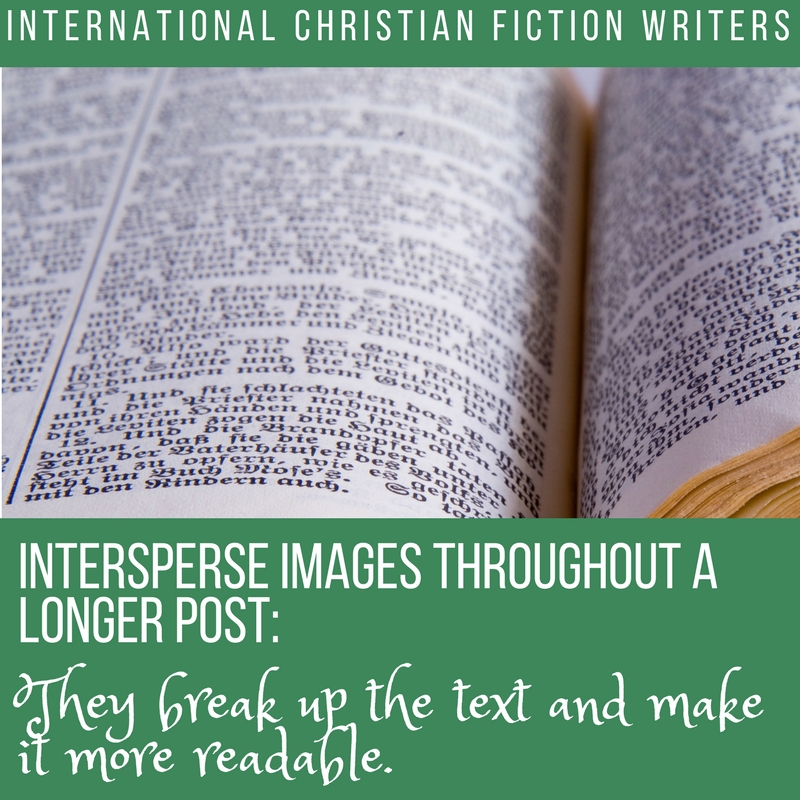

Use design software such as Canva to brand your images, so your images stand out to someone randomly scanning through Feedly. And include your killer title with your image—that will help when you’re sharing to visual sites like Instagram and Pinterest (see 10, below).

If you’re posting on a group blog like ICFW, include your author photo, bio, and social media links at the bottom of the post.

9. Add Your Byline

Tell your readers who wrote the post. This is especially important if you’re writing for a group blog with multiple contributors. Some people will choose to read the post because you wrote it. Make it easy for them to know they want to read this post.

10. Promote Promote Promote

Note: promote promote promote does not mean spam spam spam.

Promoting means sharing your post with your target audience using relevant social networks.


If your post is about your multi-author romance giveaway, share in places where romance readers congregate (hint: not LinkedIn).

I use Buffer to share to Facebook, Google+, Instagram, Pinterest, and Twitter—their Power Scheduler means I can even schedule multiple posts at once. A few clicks, and it’s done, with a unique message for each network (e.g. one or two #hashtags on Twitter, but more on Instagram).

Why these networks?

  • For my reader-writer-reviewer posts, my target reader is on Facebook, Instagram, and Pinterest. Many are also on Twitter, and it takes only a few extra seconds to get Buffer to share to Twitter as well.
  • For my writer-editor posts, my target audience is on Facebook, Pinterest, and Twitter. The beauty of Pinterest is that people can follow specific Boards, so people who aren’t interested in writing can choose not to follow my writing-related Boards.

I share on Google+ because that is indexed for SEO purposes. Translated: sharing to Google+ means Google is more likely to show my blog post (or Google+ share) to someone who is searching for posts on my topic.

The other reason for sharing or promoting is that some blog posts get more traction on social media than on the actual blog. For example, my weekly Bookish Question often gets no comments on the actual blog post, but always gets Likes and Comments on Facebook and Instagram (especially Instagram).

One request: if you’re a member of a group blog like ACW or ICFW, consider using a programme like Buffer to share everyone’s posts, not just your own. Because this is a community. Let’s work together and help each other.

11. Engage

You finished your blog post with a question, right? Now it’s important to check back and make sure you respond to answers (and other comments). And don’t forget to check your social media networks and respond to comments there as well.

Readers want to connect, to engage. That means responding to comments in a timely manner.


That’s it. My top blogging tips. Is there anything you don’t understand or you’d like more information on? Or anything you’d like to add? Let me know in the comments.


About Iola Goulton


Iola Goulton is a New Zealand book reviewer, freelance editor, and author, writing contemporary Christian romance with a Kiwi twist. She is a member of the Sisterhood of Unpronounceable Names (Iola is pronounced yo-la, not eye-ola and definitely not Lola).

Iola holds a degree in marketing, has a background in human resource consulting, and currently works as a freelance editor. When she’s not working, Iola is usually reading or writing her next book review. Iola lives in the beautiful Bay of Plenty in New Zealand (not far from Hobbiton) with her husband, two teenagers and one cat. She is currently working on her first novel.

Thursday, June 9, 2016

You Love Your Facebook Page—Let Your Fans Love It, Too: Boost That Post ~ by Patricia Beal


So much has changed in my life since my last post. My husband retired from the U.S. Army, and I have a day job for the first time in 10 years. I'm back in civil service, writing and editing for the Army like I used to (before my very long baby break). Because that wasn't enough change, we also moved to a different house, a house with treesa luxury in the El Paso desert. And my car of 16 years gave up on me, so I have a new car, too.

What does any of that have to do with Facebook? One thing: If I'm busy writing about Facebook, I'm not thinking about how scared I am about all that's changing and about my struggle to cope with it. If you're someplace similar, here's a precious sermon my pastor preached in mid-February and that's been a life saver for me: The Survivor's Guide to the Wilderness (the first sermon in this Numbers series, at the bottom of the page).

Enough front matter. Here we go. A bona fide Facebook post.
If you want to see a lot of activity on your Facebook author page, post often, boost your posts, and make sure your posts are uniquely yours (brand) and fun to share.

Post often.
I schedule a post for each day. It goes live at 3 a.m. El Paso time because it catches Brazil waking up (most of my fans are from Brazil, where people love ballet, travel, and Jesusmy brand in a nutshell). You can get away with a post every other day, but don't drop below that. 

Don't stress about Facebook posts constantly either. Schedule dozens of posts in one sitting and then just show up once or twice a day to like comments and show people you appreciate them. I don't have to produce a new post until July. June is already created, scheduled, and boosted.

Boost your posts.
The vast majority (95%+) of the people who've liked your page are not seeing your posts. Unfair? Totally. Can you change that? Not really. Not significantly. No amount of hashtags or targeted images will get the average page user beyond 10% reach.  

You have to boost your posts. With a $3 boost, I can reach between 1,500 and 3,000 of my fans (out of the 7,623 I have), depending on how well the post performs. I also spend $1 a day promoting the page and get about 100 new fans a week. 

Why bother? Why spend? I do it because I love the people and love the interaction. I have fans from almost 50 countries following me, and I love them all. I gave up gourmet coffee and brew something simple at home instead, so I can reach as many fans as possible with my posts. 

But don't spam when you boost. I made that mistake in the beginning. When you click on the boost rectangle, select "people who've liked your page" only. If you're creating an ad for a book you're promoting, then it's okay to target beyond your page fans.


Make sure your posts are uniquely yours (brand) and fun to share.
Sometimes I think that too many Christian author pages look the same, sound the same, and feel the same. Don't be afraid to brand yourself and be different.

Explore what's uniquely yours. I have the ballet thing going. Candee Fick and Kelli Hughett have football. Candee is now getting her fans into tap dancing, too. K.S. Moore has NASCAR. Have fun with it. 

And when people share your awesome posts, you often get new fans, so make sure you keep that in mind when creating content. Feel free to poke around my page. On Sunday I had 24 shares + 12 on Monday + 19 on Tuesday: www.facebook.com/patricia.beal.author 

These are my main ideas, but there's so much about Facebook that I don't know. How do you manage your page? What are your tricks?

Patricia Beal writes contemporary Christian fiction and is represented by Leslie Stobbe of the Leslie H. Stobbe Literary Agency. Her debut novel, A Season to Dance, comes out in May of 2017 (Bling! / Lighthouse Publishing of the Carolinas). 

She’s a 2015 Genesis semi-finalist and First Impressions finalist. She graduated magna cum laude from the University of Cincinnati in 1998 with a B.A. in English Literature and then worked as a public affairs officer for the U.S. Army for seven years. She and her husband live in El Paso, Texas, with their two children. 


Patricia is very active online and loves to connect with readers. 

Goodreads - www.goodreads.com/bealpat 
Facebook - www.facebook.com/patricia.beal.author 
Pinterest - www.pinterest.com/patriciasbeal 
Twitter - www.twitter.com/bealpat 
Web - www.patriciabeal.com

Thursday, November 13, 2014

Strike It Out


I have been out of the loop lately, largely because I have recently become an "empty-nester". After twenty three years of having children in the house all hours of the day and night, my wife and I now find ourselves in the strange position of being back were we started during our courtship and the first years of our marriage. We still speak to our children every day (mostly by Skype because they are both overseas) but it's not the same.

Having so much extra free time has lead to a certain amount of retrospection, especially in regard to our success or failure in the parenting department. Were we too strict? Were we not strict enough? Did we give enough guidance? Did we give too much guidance? At the end of the day, all we can do is trust that God is in control and know that we have done the best we can.

One thing that I have noticed during my chats with my children is that they now recount things to me that they have discovered about life in the big world that I clearly remember telling them, often many times. Back then they did not seem to take my fatherly advice on board. Later, having experienced it for themselves, they get what I was trying to say. Some things, it seems, can only be learned by experience.

And so it is with me and my writing. There is an awful lot of advice out there for writers. Sometimes it seems that people spend more time writing about writing than actually writing (just as I am doing now, for example). I do appreciate this advice, however, because, let's face it, I need all the guidance I can get, but sometimes the nugget of wisdom goes over my head. Like my kids, I need to experience some things before I get them.

These gentle "eureka" moments can happen when I am editing one of my manuscripts, but it is usually when I am reading something by a best selling author who really should know better. It's at times like this that I want to contact the author and tell them what they are doing wrong. It's not a judgmental thing. I'm well aware of the multitude of planks in my own eyes. Rather, I feel the need to help the author not make the same mistakes I have been making for so long.

One particular piece of advice that has become clearer to me over the years, I honestly did not understand it when I first read it. Now it makes perfect sense and I do try to follow it at all times. Sometimes I need the help of an unbiased reader to point it out but generally I manage to spot it myself. What is the mistake? Well, rather than explain let me give you the snippet of advice given by a college tutor, as quoted by Samuel Johnson:

'Read over your compositions and where ever you meet with a passage which you think is particularly fine, strike it out.'

When I first read this my response was: "Okay, but why on Earth would I want to remove good writing?" If you are not sure what this means then there is a simple test. Have you ever written something (a sentence or a paragraph) that you immediately wanted to show someone? Or, from a different perspective: have you ever succumbed to an invitation on a social website to post a favourite piece of your own writing? If so, then you need to take heed of this advice.

One thing I have noticed with my own work is that my beta readers seldom comment on my favourite passages. Usually, they remark on a piece of text that I considered normal or even dull. I may hover around them, waiting for them to get to the "good" bit, and watch with some dismay as they read past it without a flicker of emotion. Horror of horrors, they may even suggest deleting that particular line.

So what did the college tutor mean, and why is it so important? For me, the best analogy would have to be animated film. According to a Pixar producer, their goal is to make the animation of a standard where the audience forgets that they are watching an animation. The aim is to tell the story. Everything else is there to support this. If the audience is distracted by the animation (because it is not good enough, or even too good) then they have failed. It's the same with the script, music, and acting. Anything that distracts the audience's attention from the story is bad.

Writing is exactly the same. As an author, our job is to tell a story. The reader should forget that we are even there. Bad writing full of typos and grammatical errors, or with a distracting voice, will pull the reader out of your story, as will writing that is overly florid. If the writing is too bad or too good, then the reader will be distracted and we have failed. But how can something be too good? To go back to the Pixar example: there was a point in one film where the animators created a character that was too life-like. They actually had to lower the standard a little because this character stood out from the rest and was distracting.

When we write a scene, we have to be careful of creating something that is (at least in our eyes) "particularly fine" just as much as we have to eradicate poor writing. While listening to the best selling novel these past few days, there were times where the prose really distracted me. It was usually a description or metaphor which, had it appeared in a poem or on the book's cover, might have been suitable. The problem was that I could almost feel the author hovering around me, waiting for me to get to that bit so that she could enjoy my reaction to her brilliance. They were all wonderfully descriptive turns of phrase to be sure, but they stood out like a sumo wrestler at a ballet. There is a time and place for sumo, but a ballet is not one of them.

So the next time you write a line that you want to show someone, or post on Facebook, take a deep breath, read it again, and seriously consider hitting that backspace button. Save it somewhere if you have to, but chances are it does not belong in your novel and you should "strike it out".