Showing posts with label Cricket. Show all posts

Friday, August 3, 2018

DEVOTION: It’s Not Just About Cricket

by Sherma Webbe Clarke | @sdwc8181 


And when they had brought their ships to land, they forsook all, and followed him. Luke 5:11(KJV)

The momentum starts to build in July. A friendly rivalry heats up. Flags wave on cars, lawns, and from storefronts like political candidates. Red and dark blue flags for Somerset versus light blue and dark blue flags for St. George’s declare fan support.

“Hey, bye, you’re wearing the wrong colors.”

“My team’s taking the cup this year!”

Like any staunch St. George’s fan, I don’t wear red in the weeks before Cup Match (the name of the event and the colloquial name for the holiday) to avoid being accused of supporting the Somerset team. The entire community, from bus drivers to shopkeepers to CEOs, engages in good-natured teasing about the other person’s team. After all, a trophy and bragging rights are at stake.


Cup Match enthusiasm is infectious. It’s an excellent time for visitors to mingle with locals and receive first-hand information about Bermuda’s culture. Everyone should go to Cup Match at least once just for the experience. The perimeter of the field fills with spectators, and the pitch is dotted with players in cricket whites. With its bats, balls, and catchers, the game loosely resembles baseball, if I may make that comparison for the benefit of those who are unfamiliar with the sport. Colorful terms such as wicket, silly mid-on, and “Howzat?” (How’s that?) are exchanged for home runs, shortstop, and foul balls. Cricket might appear sedate to the unfamiliar onlooker, but the crowd is another story. Engaged, loud, and sun-kissed spectators share their knowledge of the game with those who wear curious or befuddled expressions.


Emancipation Day Plus Somers Day Equals Cup Match 


Cup Match officially began in 1902, and it falls on the Thursday and Friday before the first Monday in August. The history of Cup Match goes beyond the frenzy of a two-day cricket match. It is comprised of two significant historical events.

The first day of Cup Match is an observance of Emancipation Day, August 1, 1834, when slaves in Bermuda were freed according to the Slavery Abolition Act 1833. Thus began the practice by former slaves to take August 1 as a no-work day. Eventually, the day evolved into a community celebration and swelled into a national treasure.


The second day, Somers Day, commemorates the event when the Sea Venture, captained by Admiral George Somers, ran aground in Bermuda in 1609. Although the survivors of the wrecked ship remained on the Island for 10 months, Bermuda wasn’t settled as a colony by the British until 1612.


Therefore, over Cup Match we remember freedom and discovery.

Discovery and a New Name 


A Christian’s story has similar themes. Can you remember when you discovered or found Christ? Some people can recall the exact time and place. I remember being baptized, publically declaring my decision to follow Him. I rose from the water free in Jesus as he promised in John 8:36: “So if the Son sets you free, you will be free indeed”. He gave me a new name, not Somers Isles or Bermuda, but Daughter of God. He wrote my new name in the Lamb’s Book of Life.

Each day men and women make emancipation proclamations in their hearts. Jesus came to this world in the flesh to set captives free from the bondage of sin. He sends us into the field to tell others about the good news of salvation. When He returns, the loud cry of joy will be raised by His people, not Howzat? but Hallelujah!


Then we will celebrate in our heavenly home for eternity.

Praise God!

Let's chat: What unique holiday do you observe where you live?


About Sherma...

Sherma is a contemporary fiction writer, amateur photographer, reading enthusiast, and wife who often takes her husband by the hand to explore nearby and far-flung areas of the globe. This wanderlust has its perks. She credits many of her story ideas to these adventures, which provide great opportunities for research for short stories and the novel series she is currently working on. Quiet, early-morning walks along the railroad trails on her home island of Bermuda provide inspiration when she is homebound. She has been awarded prizes for short stories written for local publications, and her inspirational writing has been included in Christian devotional books: Grace Notes and Blessed. Sherma is a member of American Christian Fiction Writers.


Wednesday, May 30, 2018

Wandering Wednesday | Cricket Down Under

By Iola Goulton | @iolagoulton


You can't live in Australia (or New Zealand) and not play or watch cricket.


If there isn't a law against it, there should be. Cricket and rugby are our staple sports, and there is more than a little international rivalry between the teams.

But cricket isn't a sport I see in fiction. I've read books where the hero played baseball or football (that's American football, not soccer). I've read Falling for Maddie Grace by Meredith Resce, which featured Australian Rules football. While there are some general market romance novels featuring rugby players (go the All Blacks!), I've never read a novel with a cricket scene.

So I was thrilled when I opened Solo Tu by Narelle Atkins, which starts with beach cricket. Beach cricket, backyard cricket, school cricket, provincial cricket, international cricket. All variations of our national summer sport.

I decided to share some cricket basics with you today, in honor of the release of Solo Tu. 


(Click here to read yesterday's post from Narelle Atkins and be in to win a paper copy of Solo Tu.)


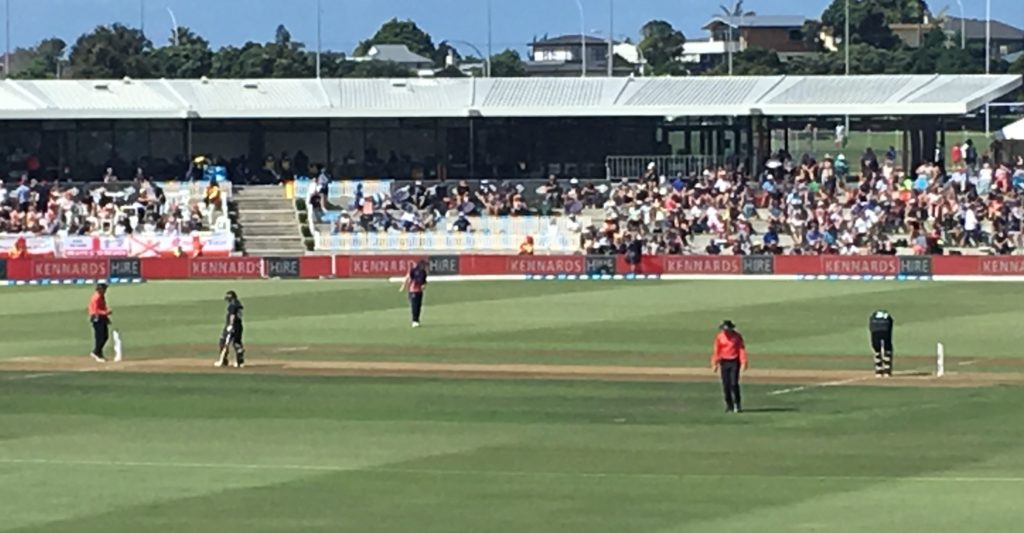
Cricket is a team sport. There are two teams with eleven players on each side, and it's played on a grass oval. The picture above shows my local ground, the Bay Oval.

Each team takes a turn to bat, like in baseball. There are two batters on the pitch, one at each end of the wicket. Here's the wicket. You can see the batters at each end, getting into position for the next ball. The two men in red are the umpires:


Batting

One batter is "on strike", which means they are facing the bowler. There are two sets of wickets, and the two batters run between the wickets to score. If the ball goes all the way to the boundary, that's a "four"—four runs are scored. If the ball goes over the boundary on the full, it's a "six". The batters don't have to run if a four or six are scored, which is an incentive—a batter can be at the crease for hours.

Unlike in baseball, several bowlers take turns to bowl. Each bowls an "over" at a time, which is six bowls or "balls". The next bowler then bowls from the opposite end of the wicket, so each batter gets a chance to face the balls—to be on strike. Bowlers bowl overarm, rather than the more sideways throw of a baseball bowler.


The main ways batters get out are by being caught out, by being bowled out (if the batter misses the ball and it hits the wickets), or run out (if the ball hits the wickets while one of the batters is still running). There are lots of other rules—here are the basics from a recent game I attended:

Rules of Cricket

(Simple? Yeah, right.)


The innings is over either when all the batters are out, or when a certain number of overs have been bowled. The most common games are 20/20, where each team faces 20 overs, or a one-day game, where each team faces 50 overs.

So cricket is kind of like baseball, except where it isn't.


But baseball has nine innings in a game, whereas cricket only has one or two. School and one-day cricket have one innings each, while test cricket has two ... spread over five days. Tests are international games, and usually played as part of a two or three-test series. That's a lot of cricket. The best part? (Or worst part, dependig on your point of view).

A test can result in a draw. Which means you play cricket for fifteen days, and there is no winner. That's testing.


Beach cricket is less formal. It's usually one innings and the boundaries are flexible—the sand dunes and the water. The teams will be even, but won't necessarily be eleven players on each side. Men, women, boys, and girls all play together. The rules bend depending on who is playing, and where. We have lots of space on the beach:

Mt Maunganui Beach

And it's a lot of fun—as you'll see if you read Solo Tu. These days I prefer armchair cricket to playing, but it's still a staple of the Aussie and Kiwi summer.

What's your favourite summer sport?


You can read the cricket scene from Solo Tu below:


Monday, February 20, 2017

Small Beginnings

by Marion Ueckermann

 
January 11th saw the start of a new school year in South Africa. For our family, this year that particular day was pretty significant. Okay, awesomely significant! My oldest grandson, Phoenix, started school. Of course, this has caused another glut of photos on my cell phone, my son’s bank balance to diminish, and my Saturday alarm clock to be set far too early for this “not-a-morning-person” person.

The first repercussion from this I’m sure you’ll understand. I mean, who doesn’t want...need a gazillion first day of school photos; first cricket match; first play; first— I think you get the idea. In fact, most of you have probably been there, done that, and gotten the T-shirt in every size and color to prove it, too.


The second repercussion... Well, who even has a bank balance once their kids start school? Scrap that, once they’re born.

As for my Saturday alarm issue... Well Phoenix decided to start playing cricket—yes, all of not even seven years old. And they play matches EVERY Saturday, unless it’s raining. At 7.30 in the morning!

It was at this weekend's match as my husband and I were watching the boys play this gentleman’s sport, picking out who already displayed incredible talent at bowling, batting, and fielding at such a tender age, that my hubby said something which stood out to me . . .


One day some of these little chaps could be standing on the great pitches of our country. Maybe even the world. That thought made me think about my own writing career—where I was a decade ago, where I am today, and where, with hard work and developing my talent, I can be in the future. Just like these little cricketers. After all, the great writers of the world didn’t start out on international bookshelves. They started with that first word, written on a blank unknown piece of paper. Just like me.


MARION UECKERMANN's passion for writing was sparked when she moved to Ireland with her family. Her love of travel has influenced her contemporary inspirational romances set in novel places. Marion and her husband again live in South Africa, but with two gorgeous grandsons hanging their hats at the house next door, their empty nest's no longer so empty.

Visit Marion at www.marionueckermann.net

If you’d like to receive information on new releases, cover reveals, and writing news, please sign up for my newsletterhttp://www.marionueckermann.net/subscribe/  
My short story, Dancing in the Rain, will be sent free to new subscribers.