Showing posts with label Florida Christian Writers Conference. Show all posts

Wednesday, March 31, 2010

Packed, Practical and Powerful - An inside look at a far-away conference


There's one thing worse than never attending a writer's conference, and that's being all geared to go and suddenly have it snatched from you.
For nine months, Marion Ueckermann and I made plans to attend the Florida Christian Writers Conference at the beginning of March. The day before our planned departure, she fell and shattered her wrist.
Some months ago, a couple of you suggested I give a "report back" of the conference when I returned from America, telling of my experiences as a non-American at an American conference. In view of what happened, I decided to let Marion ask me questions, and I'll try to answer them. Enjoy!

Marion: Hi Shirl! Remind me. How far did you actually travel?
Shirl: In 11 days I travelled 30,382 kilometres (18,878 miles). That’s over 75% of the earth's circumference (at the equator)
Marion:How long did the trip take from the time you left your home in Port Elizabeth, until you arrived at your destination hotel in Orlando?
Shirl: I left home at 10:30 S.A. time (GMT+2) on Saturday 27th February, and arrived at the hotel in Orlando on Monday 1st March at 15:00 Florida time (GMT - 5). 19 1/2 hours of that was actual flying time. The rest was in transit. I also spent nearly 24 hours with family in Johannesburg en route.
Marion:What was the venue like?
Shirl: Stunning! The auditorium is large, well-lit and attractive. The classrooms are well-equipped. The scenery reminded me of Lord of the Rings, especially in the early morning with the mist rising over the lake. I found a few minutes spent outside in the beauty and tranquility was just what I needed for a quick recharge.
The bedrooms are comfortable with en suite bathrooms. Of course I had a two-bed room all to myself (sigh). They also provided me with the loan hair-dryer we had requested in advance, as ours wouldn't have worked on the American power system.
Marion: They say that Africa isn’t for sissies, but I believe Lake Yale has alligators?
Shirl: I believe so, but the weather was so cold they wisely stayed at the bottom of the lake. (America had heavy snow-falls my first day in Orlando and it was pretty cold a lot of the time.)
Marion: What was the program like?
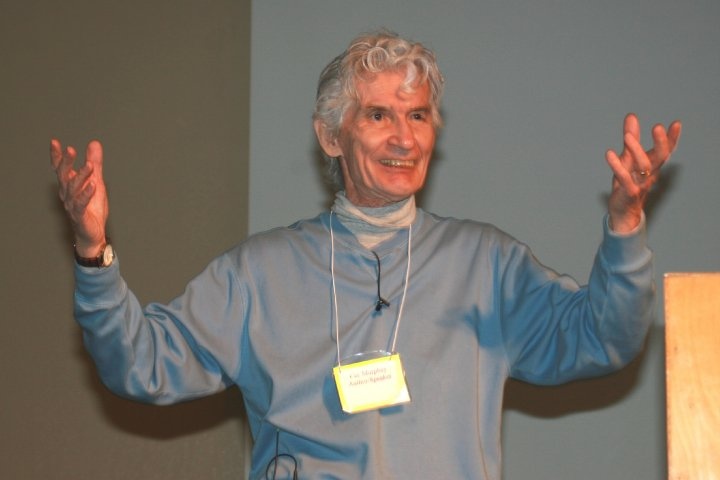
Shirl: As the title says: Packed, practical and powerful! The worship was inspiring, the teaching at the general sessions excellent. The material presented throughout the conference covered everything from finding ideas, writing queries and submitting, to how to approach an editor or find an agent. There was teaching on traditional publishing as well as self-publishing, and they even had a Teen-track. This popular continuing class produced two of the overall conference winners. (Picture shows best-selling author, Cec Murphey.)
At the beginning of the conference, we selected a continuing class from a possible 12. We attended this class for a total of six hours throughout the conference. We also attended 8 (out of a possible 81) hour-long elective workshops. Throughout the day, we slipped out of our workshops to attend 15-minute one-on-one appointments with editors, agents or faculty members.
Lunch and supper times were not exempt. Agents, editors and other faculty members hosted tables, and we selected who we wanted to sit with during the meal. I often wondered how these poor people ever managed to eat with all the questions fired at them throughout the meal.
Marion: Was the food very different?
Shirl: Not at all. The meals were excellent, and similar to what we eat in South Africa. Not like last time at Sandy Cove where food was often different, especially at breakfast.
Marion: How did you get on with the American people? Did you have any problems understanding one another?
Shirl: Not at all. The other conferees were very friendly and fun to be around. I had no problem with accents as we have Americans in our lounge every night on TV. To my surprise, they seemed to enjoy my South African accent. I know most of the words where our English is different to the American English, but I found it more daunting in real life than on paper. So I put my luggage in the boot, walked on the pavement, and to their consternation headed for the driver’s side of the car every time.
Marion: Were you the only non-American?
Shirl: I was the only overseas conferee but there were a few Canadians.
Marion: As the only person from overseas, did you not feel the odd one out?
Shirl: No, not at all. After expressing amazement that I'd come so far, they treated me like one of them.
Marion: What was the most beneficial part of the conference program?
Shirl: That's a difficult question. For me personally, this would have to be the interviews—after I got over the initial nervousness.
Marion: Was there any moment that stood out for you?
Shirl: Many. One special moment was meeting Yvonne Ortega for the first time. We’ve been critique partners for nearly seven years, but this was the first time we've met. We recognized each other across the parking lot. (Picture - L-R, Shirl, Billie Green - conference organiser, Yvonne Ortega)
Marion: Out of all the things you learned, what was the most challenging?
Shirl: During a panel session comprising five agents, one of them said something like, "Editors are more interested in your platform than your good writing." I heard this several times during the week: the importance of building your platform.
Marion: Were there any speakers or workshop leaders who really stood out for you?
Shirl: They were all good, but I think the workshop leader that impressed me the most was Craig von Buseck of CNN.
I attended two workshops by him, both in that dreadful just-after-lunch-I-need-a-nap time. Yet not once did I feel sleepy. He moved around, varied his voice, and kept our attention throughout. Apart from his topics, that was another good lesson for me: How to hold people’s attention.
Marion: What was the worst moment of the adventure?
Shirl: You mean, apart from the realisation I was travelling alone?
That would be when I went to plug in my laptop the first evening in Orlando and discovered the new lead for the American socket didn't fit my laptop. I was talking on Skype with Rob when the battery died. I had no way to tell him what had happened.

I felt so alone and out of contact with my world. My cell phone didn't operate in America so I couldn’t text home. My room-mate was in hospital in South Africa. My family were back home wondering where I'd disappeared to. And I had no clue where I’d be able to get another lead. (The next morning I caught a shuttle to the Orlando Mall and found a computer shop. Problem solved.)
Marion: Looking back, do you have any regrets?
Shirl:There were a couple of people I would have loved to chat with, or as the Americans say, "visit with", but there was no time. Inevitable, but sad.
Marion: So would you encourage other South African writers to attend a writer’s conference in the America?
Shirl:Absolutely. We have no comparable opportunity in S.Africa, and I suspect most other countries, where you can learn so much about writing in a few days. The interaction with so many other writers cannot be equaled.
Marion:Thanks, Shirl. I wish I’d been with you, but the Lord must have His reasons. Thank you Marion. And yes, you have no idea how often I reminded myself that God was in control.

Shirl:As a final thought to all: Both my conferences have come about as a result of intense prayer and miracle answers. Rob and I don't have this sort of money. The Lord has provided in amazing ways. If He can do it for me, He can do it for you—if you're really serious about your writing.

In closing - if you've been to a writers' conference, what one thing benefitted you the most? 
If you haven't been, what would be the one thing you’d most look forward to?
P.S. To read more about the whole Florida Adventure, go to the special section of my website: http://bit.ly/aZujwi

Friday, March 26, 2010

Oranges and Lemons – A Slice of Life

by Marion Ueckermann

(Book giveaway – Thin Places by Mary DeMuth)


As a child one of my favorite games was Oranges and Lemons. Does anyone remember this game? Do children still play it, or am I revealing my age here?

Oranges and lemons, Say the bells of St. Clement's
You owe me five farthings, Say the bells of St. Martin's
When will you pay me? Say the bells of Old Bailey.
When I grow rich, Say the bells of Shoreditch.
When will that be? Say the bells of Stepney
I do not know, Says the great bell of Bow
Here comes a candle to light you to bed
And here comes a chopper to chop off your head!
(Chip chop, chip chop, the last man's dead)


According to Wikipedia, this is one of the common modern versions. My childhood one was slightly different with far less bells involved. As we filed through an arch made by two players facing each other with their arms raised in the air and hands clasped together, we chanted something like this . . . in singsong intonation:

 Oranges and lemons
The bells of St. Clemens
You owe me a farthing
When will you pay me?
Tomorrow or the next day
When I grow rich!
Here comes a candle to light you to bed
Here comes a chopper to chop off your head
Chip chop, chip chop, the last man's head is off!


On the last line, squealing players scurried through the arch, hoping not to lose our heads, praying we’d stay “alive” to run the gauntlet again in the next round.

With each round of the game, the arch became longer. Axed players would form successive arches, leaving the last player wondering if he’d ever see light at the end of the tunnel.

Talk about gruesome games for kids! I think The Guillotine Run would have been a more appropriate name than Oranges and Lemons.

Life’s a little like that game—a mixture of bittersweet happenings. Sometimes we’re thrown juicy, sweet oranges that manifest in magic moments. Other times life dishes out lemons—experiences so sour and bitter they’re hard to swallow.

 I recently had one of those “When life throws you lemons . . .” experiences when I fell and broke my wrist. The next day I was due to fly to America with fellow writer, Shirley Corder, to attend the Florida Christian Writer’s Conference. Instead, I landed up in surgery with doctor’s orders of “No flying for two weeks!” As my wrist hit the floor that Saturday morning, I watched nine months of preparation, anticipation and excitement disappear in a single moment. If it hadn’t been for my faith, I would never have been able to say “I don’t understand, but God . . .”

Faith allows us to look at our lemon moments and decide to make cool, refreshing lemonade. It allows us to see Jesus, THE light, at the end of our tunnels because we know that “in all things God works for the good of those who love him, who have been called according to his purpose.” [Romans 8:28 – NIV]

When I wrote my Nano novel, The Red Floor (not published), in November last year, based on my mother’s childhood years in an orphanage, I came face to face with many of her lemon days. Oh, I had heard all her stories too many times to tell, but it wasn’t until I wrote her story—until I, the writer, became her—that I really understood the bitterness of her childhood. I felt what it was like to own only two pairs of shoes—one for school, one for church—spending most of the time barefoot, even during cold winter months. I tasted the crudest of sweets made from sugar and molasses that were enjoyed only on monthly pocket money days. But I also felt castor oil run down my throat, experiencing its purging effects as social workers tried to eradicate those brief, sweet moments. I watched as worms crawled through insipid, meager servings that couldn’t be stomached and tasted dirty, dry oranges found abandoned on dusty pavements in an attempt to keep hunger away. I watched with eight-year-old eyes as social workers snuggled under warm blankets not meant for them, and trembled with cold and fear on a train that chugged its way to an unknown future. I watched, I felt, I tasted, I experienced—and at the end I knew . . . my mother had made bucket loads of lemonade during her life.

Great stories abound from orange and lemon moments. Fiction and nonfiction author, Mary DeMuth, has published her lemon moments in a powerful and courageously honest memoir titled “Thin Places” released in January by Zondervan. Bitterness resulting from childhood sexual abuse, the death of her biological father, and years of parental neglect could have soured her life, but the sweet smell of orange blossoms clings to the pages of this book as Mary derives victory through her faith in the God who sees.

Mary will give away a signed copy of Thin Places and will post to a US address. A draw will be held within ten days from comment submissions. Should you wish to be entered in the draw and can supply an American postal address, please add an email address to your comment, replacing @ with (at). I will contact the winner to obtain a postal address.
 Visit Mary on http://www.marydemuth.com/ or http://www.thewritingspa.com/

"Void where prohibited; the odds of winning depend on the number of entrants. Entering the giveaway is considered a confirmation of eligibility on behalf of the enterer in accord with these rules and any pertaining local/federal/international laws."

MARION UECKERMANN’s writing passion was sparked in 2001 when she moved to Ireland with her husband and two sons. Since then Marion has been honing her skills and has published some devotional articles in Winners at Work as well as inspirational poetry online and in a poetry journal. She has written her first Christian Women’s novel (unpublished) and is currently completing the sequel. Marion now lives in Pretoria East, South Africa with her husband, sons and a crazy black ‘Scottie’. A member and moderator of the South African Christian Writers Group, Marion can be contacted via email on marionu(at)telkomsa(dot)net or through her website www.inkslinger.co.cc

Wednesday, February 3, 2010

Literary Abandon


by Marion Ueckermann


Shout “Nano!” and immediately the mind conjures up images of minute things: nanobot (microscopic robot); nanosecond (one billionth of a second); nanotechnology (technology for microscopic devices); nanofossil (a very small fossil); and so on. You get the picture, I’m sure. Yet talk to anyone who’s ever tackled NaNoWriMo, fondly referred to as NaNo, and each participant will tell you that there’s nothing small about this Nano. In fact, it’s big . . . really big.

What, you ask trying hard not to look confused, is NaNoWriMo? I’ll tell you. National Novel Writing Month is a frenzied, fun-filled November where writers take a seat-of-the pants approach to novel writing. The goal? – to write a 50,000 word novel from scratch in 30 days.

But NaNo is not for the faint-hearted; and it’s definitely not for those who value their sleep or their social life. For one crazy month, nothing else matters but word count.

The first NaNoWriMo took place in July, 1999 with 21 writers. 2008 saw 120,000 writers worldwide taking their place at the starting line of NaNoWriMo. But only 20,000 finally made it over the 50K mark, entering their names into the annals of NaNoWriModom forever.

A total collective word count of 2,427,190,537 was tallied in November 2009 by 167,150 participants – 40% more writers penning 48% more words than the previous year, proof that the NaNo craze is catchy. Last year also saw 32,173 winners, giving the highest win rate in modern NaNoWriMo history.

On the NaNoWriMo website, participants can watch weekly motivational videos by NaNoWriMo founder, Chris Baty. Throughout the month, Wrimos also meet online and in person at coffee shops, book clubs, restaurants . . . wherever, to encourage and spur each other on to cross the finish line by the midnight month end deadline. Whether these zealous novelists win or lose, they’re certainly stars for trying.

Working hard to prepare for the Florida Christian Writers Conference that Shirley Corder and I are attending at the end of this month, my natural response to Shirley’s “Are you going to do your first NaNo this year?” was an emphatic “No!” It had taken me months of hard work to add 50,000 words to my current novel. There was no way I could write 50,000 words in just one month! Shirley, a seasoned and experienced writer, was struggling with the decision herself of whether to go for a fifth consecutive NaNo win or not. She too was frantically preparing for our US conference.

Eleven days before NaNo, I finally relented, as did Shirley, and we signed up for NaNoWriMo 2009. Of course we both agreed that we were most definitely certifiable, but still we chose to join the rest of the crazy Wrimos worldwide.


After ten days of outlining, designing a cover (not a requirement), choosing a name for my novel, and adding new NaNo friends to my profile, I was off to a flying start. However, when the pressures of life made meeting my daily writing goal of 1667 words nigh on impossible, I soon discovered how difficult it was to play catch-up. The backlog kept multiplying and five days before the end of NaNo, I was 13,258 words behind my daily target, with 21,591 words still left to write — nearly half the entire NaNo requirement! If I thought writing 50,000 words in one month was going to be tough, how on earth could I even begin to imagine I was able to do what was still required to finish?

“Never say die,” I said. I was determined not to fail no matter how impossible the prospect of winning. I’d come too far.


I pushed myself beyond what I thought I could do during those last few days. My highest word count in one single day? - 7,059 words. At midnight on 29th November, I proudly crossed over the finish line. What a feeling to finally write: “It’s done . . . it’s dusted. Now to rest.” I could truly say with the Apostle Paul when I wrote that last word, “I have fought the fight, I have run the race”.

NaNoWriMo holds bittersweet memories. But the sweetest came in the form of an email from my son. “Congrats, Mommy. We’re so proud of you!”

If you’ve done NaNo, tell us about your experience in three words or a sentence. And next month I’ll share how NaNoWriMo gave me a deeper perspective of my mother’s childhood as I furiously penned her orphan’s story in my 2009 NaNo novel, “The Red Floor.”


MARION UECKERMANN only discovered her writing talents later in life. Her passion for penning poetry was sparked in 2001 when she moved to Ireland with her husband and two sons. Since then Marion has been honing her skills and has published some devotional articles in Winners at Work as well as inspirational poetry online and in a poetry journal. She has recently authored her first full-length Christian Women’s novel, Prodigal, and is looking for a publisher. Ms. Ueckermann now lives in Pretoria East, South Africa. A member and moderator of the South African Christian Writers Group, Marion can be contacted via email to marionu(at)telkomsa(dot)net or through her website www.inkslinger.co.cc


Friday, January 8, 2010

Present Time

by Marion Ueckermann


A 2002 article by Carol Landman, states that 600 000 children had been left orphaned by the scourge of HIV/AIDS sweeping through South Africa and that the number of these orphans was expected to increase to two million per year by 2010. In 2007, there were already 1,400,000 aids orphans in South Africa.

Every year, just before Christmas, our church runs a special Shoebox project for the orphans at Mount Carmel Baptist Church in the township of Soshanguve, 45km north of Pretoria. Although I’ve been involved with this project for the past two years, it was only in researching for this blog that I discovered the name Soshanguve stands for the languages spoken at this township – SOtho, SHAngaan, NGUni, VEnda.

Congregants of Waterkloof Baptist Church have been eager to assign their name to a child from a list supplied by Mount Carmel. They then get busy covering a shoebox in bright paper, wrapping the lid separately so that when the box is empty, the child can still use it as a beautiful storage box. The box is then filled with toys, sweets, writing materials, books, clothing, etc. – anything suitable to the age and gender of that child. Benefactors are encouraged to write a short note to the child and slip it inside the box.

As the number of orphans increases each year, so does the ministry. In 2007, around 128 shoeboxes were taken to Mount Carmel and in December 2008, we delivered 165 shoeboxes. Talk about feeling like Santa’s little helpers.

When our church announced in September last year that there were nearly 200 names on the Mount Carmel list, AND that they had decided to do the same project for the children at Mmamethlake township – over 50 boxes there – I groaned. How on earth were we going to reach a goal of 250 shoeboxes? But God was faithful, as were his people, and every single child at Mount Carmel received a shoebox gift on Sunday, 6 December 2009 (even visitors who were not on the list), as did the Mmamethlake children.

There’s an ancient phrase (earliest known record from St. Marher, 1225), predating modern English that reads: "And te tide and te time þat tu iboren were, schal beon iblescet." The modern English version, “The tide abides for, tarrieth for no man, stays no man, tide nor time tarrieth no man," has evolved into the present day version: "The clock is running. Make the most of today. Time waits for no man. Yesterday is history. Tomorrow is a mystery. Today is a gift. That's why it is called the present."

Emily Dickinson expresses this artfully in her poem "Yesterday is History."

Yesterday is History,
'tis so far away --
yesterday is Poetry,
'tis Philosophy --

Yesterday is Mystery --
Where it is today --
While we shrewdly speculate
Flutter both away


We stand on the threshold of a new year. Today is God’s gift – his shoebox to us, his children.

As a fiction writer, I’ve already seen a Christian Writers’ Conference in Florida, USA during March waiting inside my 2010 shoebox. But I’m hoping the box also contains some time and knowledge. Time to complete the two writers’ courses I’ve purchased, and knowledge from those courses to improve my writing skills. Of course, a start on the road to publication would be a wonderful inclusion too.

As a fiction reader, I’m hoping God’s gift of this new year contains some personal relaxation time so that I can dive into all the unread Ted Dekker books that are patiently waiting on my bookshelf. And it would be really great if there’s a little space left inside my box for the shipment of more Eric Wilson and Brandilyn Collins books to South African shores.

Dear Fiction Writers and Fiction Readers, as you hold God’s shoebox in your hands, secretly lifting the lid to sneak a peek inside, what is it you’re hoping for? What are you trusting it will contain?

Matthew 7 v 11 says: “If you, then, though you are evil, know how to give good gifts to your children, how much more will your Father in heaven give good gifts to those who ask him!” God longs to see our faces light up like little children as we unwrap each perfect gift from above.


MARION UECKERMANN only discovered her writing talents later in life. Her passion for penning poetry was sparked in 2001 when she moved to Ireland with her husband and two sons. Since then Marion has been honing her skills and has published inspirational poetry online and in a poetry journal. She has recently authored her first full-length Christian Women’s novel, Prodigal, and is looking for a publisher. Ms. Ueckermann now lives in Pretoria East, South Africa. A member and moderator of the South African Christian Writers Group, Marion can be contacted via email to marionu(at)telkomsa(dot)net or through her website www.inkslinger.co.cc

Wednesday, January 6, 2010

N.J.Lindquist interview with Alice Valdal


Alice: Eileen Watson mentioned Write! Canada on this blog a few weeks ago and I'm following up on her post by interviewing N.J. Lindquist, one of the founding organizers of that conference. N.J. could you tell us a bit about yourself and your writing journey?

Wow! That could take a while.
Books and magazines were my best friend when I was growing up and I’ve always been drawn to making up stories and thinking about things in new ways. I was an only child who was adopted, so I was rather lonely and I felt a bit like the ugly duckling.

My first published piece was an anonymous letter to the editor of our small town local newspaper when I was 12. I didn’t get much encouragement from teachers on my writing until I got to university and finally learned to write essays, thanks to my first year English teacher. I actually ended up winning the English medal when I graduated.
I won’t bore you with the rest of the details, but I became an English teacher, got married, took a correspondence course in writing, put my writing aside to raise (and homeschool) four sons, and was very active in church leadership. My first book was published by Moody Press in 1991. Since then I’ve written articles of all kinds, columns, short stories, a Christmas play, and had 10 other books published. I’ve done editing , and I’ve been teaching writers since 1992.

In 2001, I realized there was an urgent need for Canadian writers who are Christian to work more closely together. With some other writers and editors—in particular, Wendy Nelles http://wendynelles.com/ I founded an association called The Word Guild (http://www.thewordguild.com/) and served as the executive director for a number of years—all as a volunteer. Wendy and I have also directed Write! Canada since 2002.
For a more detailed bio, http://www.njlindquist.com/njlindquist/n-j-lindquists-bio/

Alice:Tell us about the Write! Canada conference. Who? Where? When?
N.J.: Write! Canada is an annual conference for writers and aspiring writers that is held at Guelph Bible Conference center about 45 minutes west of the Toronto, Ontario airport. The conference celebrated its 25th anniversary last year. This year’s conference is Thursday to Saturday, June 17 – 19, 2010.
Our keynote speaker is Joel Freeman, international speaker and coach, and author of the book If Nobody Loves You, Create the Demand, which we felt was an appropriate topic for Canadian writers who are Christian.
In addition to three keynote addresses, the conference offers continuing classes , writing intensives, and workshops, editor/agent appointments, manuscript critiques, worship, a publishing symposium, and lots of networking. While we do have classes for authors and aspiring authors, we know that there are many other types of communication. This year our continuing classes will include: "Writing from Your Life," "Eight Step Editing," "How to Craft a Novel," "What Journalists Need to Know/Do for the Future," "How to Develop a Speaking Ministry," "Writing Poetry," and a small group intensive for people writing biography or memoir.
Our website is http://writecanada.org/. We’re just finalizing faculty and we’ll be putting up details in the next month or so. You can see the pages from 2009 in the About Us section.

Alice: Is the conference open to non-Canadian participants?
N.J.: Yes. It’s open to anyone. We have a mix of faculty from both Canada and the United States. Attendees come from all over Canada, but we do have some Americans who come on a regular basis, and we’ve had a few other registrants, including one from Africa. We normally have about 225 to 250 people in total.

Alice: Can you report any sales made as a direct result of an author attending the conference? N.J.: Yes. Some of our sales are for book manuscripts, and others are for smaller items and articles. And we have had people sign with agents as well. Or connect with other writers who can encourage or even mentor them.

Alice: International Christian Fiction Writers was formed to support authors whose work is set outside the United States. Do you have any words of wisdom for such writers trying to sell to the mostly American publishers?
N.J.: I’ve had three US book publishers, including St Kitts and Moody Press, and have been published in US magazines and taught workshops in the US. I’m not really opposed to the idea of having a US publisher. But I do think we need to think about what we’re doing in the "big picture" and perhaps establish ourselves in our own country and not merely try to be another "US author." I’m also very concerned that my own culture’s Christianity be reflected honestly, and trust me, it really isn’t the same as the US Christian culture that has dominated Christian publishing for the last number of years.
Don’t get me wrong, I totally understand the desire to get into what may well be a bigger market, but does it make sense in the long run? To be acceptable to American Christian publishers, I will probably need to set my novels in the United States and use only American spelling and phrases, and write for the American Christian culture. And if I do that, what will I be leaving for my children in terms of a Canadian Christian culture?
Why not instead work to develop a market in my own country first, and then perhaps sell my work into other countries, including the United States?
I wrote a piece on this subject for Christian Fiction Online in May. You can read it either on their site or on one of my blogs.

http://christianfictiononlinemagazine.com/may-09-blitz_international.html
http://bluecollarwriter.com/writing/finding-my-place-in-god’s-plan/
If you still feel God wants you to write for the American market, you’re going to have to follow the same rules as American writers: know your audience; know the area you are working in; develop a platform in the US; go to conferences where you can meet other writers, editors, and agents; get articles and stories published in magazines or online; and develop a career.
This is all made more difficult (or more exciting) by the fact that the entire publishing industry is in total flux right now, and no one knows where it is going to end up. It just might be a time of great opportunity for people who are willing to try new things, work hard, and work together.
FYI: I do a lot of blogging on writing issues at my Web site http://www.writewithexcellence.com/

Alice: Anything you'd like to say to this group of authors writing from all around the world?

N.J.:Just this. God created you and He put you in the country where you live, and presumably in that town or city or farm. So look around and see how you can use your gifts and talents where you are now. If He wants to use you beyond that area, great. But don’t ever feel He put you in the wrong place. He can and will use you exactly as you are.
For my proof of that fact, you might want to check out my own story, "The Diamond Ring". J
Alice: Thanks N.J. You've given us lots to think about. Good luck with the conference.


You can learn more about Alice Valdal at her website http://alicevaldal.com/


Saturday, November 21, 2009

Out of Africa

Hi to you all from a land shrouded in mystery and intrigue.

Let me start by saying that any apparent spelling or grammar "errors" are probably because I'm writing in British English. That's one of many challenges of writing for this International blog: deciding which English to use. And by the way, all the photos here are taken in South Africa.

I’m writing to you from the “Windy City” of Port Elizabeth, on the coast of usually-sunny South Africa. (Yes, that's us on the left.)

In March of next year, a friend and I will be flying to America to attend the Florida Christian Writers Conference.

Like many people, I love to travel. When I can’t go by plane or car, I like to do it from the comfort of my armchair.

I would like to invite you in this, my first post to this blog, to Come fly with me to the magnificent continent of Africa, and particularly South Africa—a world in one land.

"You can get out of Africa, but you can never get Africa out of you."

This has been proved over and over by people who have left this continent. Watching the popular TV programme, Amazing Race, I have often wondered at the excitement when contestants are sent to Darkest Africa. For some, there is the thrill of the unknown. But for the Afro-Americans, there is inevitably a sense of home-coming. Their roots are in Africa, even though their ancestors were dragged away by slave-traders generations ago.

For centuries, many of the scenic and cultural wonders of Africa have remained hidden from the rest of the world. This land could be backdrop to a vast variety of tales of mystery, intrigue and adventure, yet few writers have accepted the challenge. Or is it perhaps few editors who have the courage to accept books written about a land of which little is known or understood?

In the secular world, South Africa is the birthplace or home to many famous authors but on this blog we’re looking at Christian International writers.

Brave Christian authors who have set their novels in Africa include Catherine Palmer, Tom Davis, DiAnn Mills, Vanessa Del Fabro, Linda Lee Chaiken, and our own Lisa Harris. I’m sure there are more. But it’s not enough.

Would you like to read stories about characters hiking a snowcapped mountain near the equator? How about adventure stories of people travelling by jeep on safari (suh-fah-ree) to see the Big Five (lion, leopard, elephant, buffalo and rhino) and other animals such as giraffes and zebras in their natural habitat? Would you enjoy reading about your hero's travels on the back of a bumpy camel across the desert? Or how about sailing down the Nile River to see ancient pyramids?

Africa is the background to millions of as-yet-untold stories. I encourage you to look through your bookshops and libraries for stories set in Africa and other intriguing countries on this amazing planet we call Earth.

Plane travel is exciting. It's also expensive. There are so many amazing countries we can fly to, so many adventures we can enjoy, even if only from our armchairs. Let's read what's available, and then ask for more.

Want a calendar or postcard of South African scenery? Answer today's question:

In ONE SENTENCE, What does Africa mean to you?

Submit your answer in the form of a comment.

In one week, I will have a vote on CWG S.Africa, an online group for Christian writers of South Africa, for the best answer. I will send a scenic calendar to the selected winner and a postcard to the runner-up to any address in the world.

Don't forget to include your name and email address (use (at) instead of @) and I'll e-mail winners for postal details. I'll also post the winners' names on the comment section of this post.

SHIRLEY M. CORDER has been an RN, a pastor’s wife and a mother, but she never expected to be a published writer. A close encounter with aggressive cancer in 1997 changed everything, and she has been writing ever since. Well over 120 of Shirley’s inspirational and life-enrichment articles have been published around the world. She is busy with her 6th novel set in South Africa as she heads for her 5th consecutive NaNoWriMo win. You can contact Shirley through her website or follow her on Twitter.