 |
| Aspiring Kenyan writers |
Not everyone writes for an American audience. A group in Awasi, Kenya, aspires to write for the children and young people of their own community. That community experienced terrible violence following the disputed elections of December 2007. Children who survived are scarred inside and out. These Christians long to see them grow up without the animosities of their parents that led to violence against other ethnic groups.
On a day in mid-August I marveled at the patchwork of vivid green, sugar cane plots below me as I flew over Western Kenya. The plane banked for a view of the harbor on Lake Victoria before landing in the city of Kisumu.
Morrice Okeh and a friend picked me up at the airport. I met Morrice last year at the Litt-World conference for majority-world Christian writers and publishers. When he heard about the writing workshop I did in Nairobi in April 2008 to produce stories for children affected by violence, he begged me to come to Kisumu where the violence was at its worst.
For an hour we drove east from Kisumu on a narrow, paved road with no shoulders, to the town of Awasi. There I met for a week with fifteen students to study plot, character development, and the use of dialog and the senses to develop scenes. One was a widow with ten children, another an orphan with a seven-year-old daughter.
 |
| Working in small groups |
A pre-school teacher proved to be a gifted storyteller. Two of the young people were the most effective writers. Tracy wrote about teens bringing about reconciliation in their divided school. Charlton wrote a rich account of the horror of fleeing a burning house and the joy of finding the character’s mother was alive and looking for him. The group has aspirations of printing their stories locally to circulate among their friends. I left my postal address and e-mail and hope they will stay in touch, but Facebook from a cell phone is less than ideal for editing.
“Is it true that there is a law in America requiring every father to provide a new house for each of his sons?” someone asked as we sat around on the final afternoon.
“Uh…no.”
“Is it true that America is so crowded that the only way a son can have a home is to add another story to his father’s house?”
Again I answered, “no.”
I was reminded of nineteenth century myths that the streets of America were paved with gold. They must have seemed no more far-fetched to those immigrants than these questions did to my new Kenyan friends.
“Do you mean to tell me that you have two daughters and no son, but your husband never took a second wife?” This from the mother of a delightful seven-year-old girl. How could I explain how much my husband adores his daughters and how little he cares that neither is a boy?
My students could only ask questions. I had the privilege of being immersed in their world for a few days.
I stayed in the home of Morrice’s father, Bishop Vincent. Most of the time he was busy with a district church conference, but his wife was extremely gracious with the little English she knew. Morrice’s wife, Quinter cooked for us on a wood fire in an outdoor kitchen to keep the heat out of the house. Her little daughter was tied to her back. She served me their own eggs, papaya and bananas, homemade chapattis and mandazis (fried bread), as well as tasty stews with rice and ugali (the local cornmeal staple.) No meal was complete without chai—hot tea boiled with milk and water. Fortunately for this soft-stomached foreigner, the bishop has a fetish for boiled water. I filled bottles daily to take with me to class.
The house was built of cement blocks, not as cool as the mud brick houses of Morrice and his married brothers that circled the courtyard. I slept beneath a treated mosquito net to avoid malaria. The spotlessly clean floor was cement, polished with red wax. The lounge was lined with couches (4!), love seats (1) and armchairs (7), each draped with a matching embroidered cover—a suitable receiving room for a bishop. A tiny pink and white lamb wandered freely in and out. After I scratched his delicate neck, I had a friend for life.
“Are there mad people in America?” my new friends wanted to know. “Are there poor people in America?”
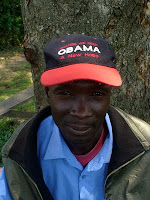 |
| One of my students |
Western Kenya is the homeland of Barak Obama’s father. Needless to say, my president is very popular there. “Is it true that many Americans believe that Barak Obama will be the one to fulfill the prophecies and unite the world?” This question was asked with a hopeful smile, not the horrified accusation of anti-Christ that I have heard on the lips of right-wing detractors. Peace and unity are very attractive to people who have seen their community torn apart by ethnic violence. It would be a great honor for one they consider their own to accomplish that hitherto unattainable goal. May their writing impact the next generation in their community with the gospel of peace.
LeAnne Hardy has lived in six countries on four continents. Her books for young people come out of her cross-cultural experiences and her passion to use story to convey spiritual truths in a form that will impact lives. Visit her at www.leannehardy.net or find out more about her recent trip to Kenya on her blog.


