Wednesday, March 31, 2010

Packed, Practical and Powerful - An inside look at a far-away conference


There's one thing worse than never attending a writer's conference, and that's being all geared to go and suddenly have it snatched from you.
For nine months, Marion Ueckermann and I made plans to attend the Florida Christian Writers Conference at the beginning of March. The day before our planned departure, she fell and shattered her wrist.
Some months ago, a couple of you suggested I give a "report back" of the conference when I returned from America, telling of my experiences as a non-American at an American conference. In view of what happened, I decided to let Marion ask me questions, and I'll try to answer them. Enjoy!

Marion: Hi Shirl! Remind me. How far did you actually travel?
Shirl: In 11 days I travelled 30,382 kilometres (18,878 miles). That’s over 75% of the earth's circumference (at the equator)
Marion:How long did the trip take from the time you left your home in Port Elizabeth, until you arrived at your destination hotel in Orlando?
Shirl: I left home at 10:30 S.A. time (GMT+2) on Saturday 27th February, and arrived at the hotel in Orlando on Monday 1st March at 15:00 Florida time (GMT - 5). 19 1/2 hours of that was actual flying time. The rest was in transit. I also spent nearly 24 hours with family in Johannesburg en route.
Marion:What was the venue like?
Shirl: Stunning! The auditorium is large, well-lit and attractive. The classrooms are well-equipped. The scenery reminded me of Lord of the Rings, especially in the early morning with the mist rising over the lake. I found a few minutes spent outside in the beauty and tranquility was just what I needed for a quick recharge.
The bedrooms are comfortable with en suite bathrooms. Of course I had a two-bed room all to myself (sigh). They also provided me with the loan hair-dryer we had requested in advance, as ours wouldn't have worked on the American power system.
Marion: They say that Africa isn’t for sissies, but I believe Lake Yale has alligators?
Shirl: I believe so, but the weather was so cold they wisely stayed at the bottom of the lake. (America had heavy snow-falls my first day in Orlando and it was pretty cold a lot of the time.)
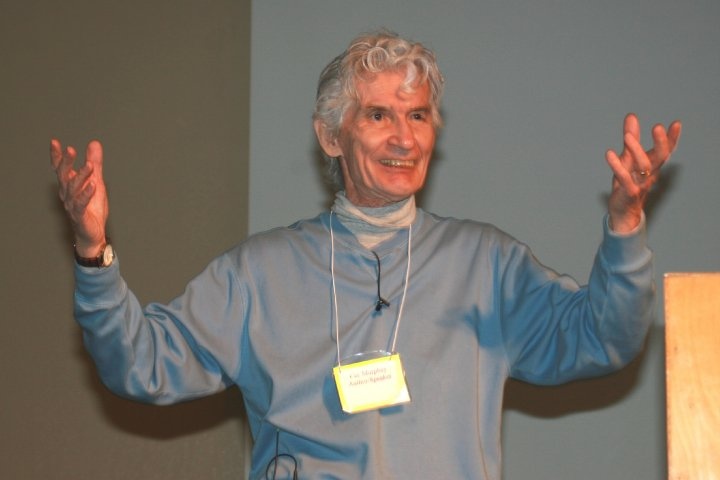
Marion: What was the program like?
Shirl: As the title says: Packed, practical and powerful! The worship was inspiring, the teaching at the general sessions excellent. The material presented throughout the conference covered everything from finding ideas, writing queries and submitting, to how to approach an editor or find an agent. There was teaching on traditional publishing as well as self-publishing, and they even had a Teen-track. This popular continuing class produced two of the overall conference winners. (Picture shows best-selling author, Cec Murphey.)
At the beginning of the conference, we selected a continuing class from a possible 12. We attended this class for a total of six hours throughout the conference. We also attended 8 (out of a possible 81) hour-long elective workshops. Throughout the day, we slipped out of our workshops to attend 15-minute one-on-one appointments with editors, agents or faculty members.
Lunch and supper times were not exempt. Agents, editors and other faculty members hosted tables, and we selected who we wanted to sit with during the meal. I often wondered how these poor people ever managed to eat with all the questions fired at them throughout the meal.
Marion: Was the food very different?
Shirl: Not at all. The meals were excellent, and similar to what we eat in South Africa. Not like last time at Sandy Cove where food was often different, especially at breakfast.
Marion: How did you get on with the American people? Did you have any problems understanding one another?
Shirl: Not at all. The other conferees were very friendly and fun to be around. I had no problem with accents as we have Americans in our lounge every night on TV. To my surprise, they seemed to enjoy my South African accent. I know most of the words where our English is different to the American English, but I found it more daunting in real life than on paper. So I put my luggage in the boot, walked on the pavement, and to their consternation headed for the driver’s side of the car every time.
Marion: Were you the only non-American?
Shirl: I was the only overseas conferee but there were a few Canadians.
Marion: As the only person from overseas, did you not feel the odd one out?
Shirl: No, not at all. After expressing amazement that I'd come so far, they treated me like one of them.
Marion: What was the most beneficial part of the conference program?
Shirl: That's a difficult question. For me personally, this would have to be the interviews—after I got over the initial nervousness.
Marion: Was there any moment that stood out for you?
Shirl: Many. One special moment was meeting Yvonne Ortega for the first time. We’ve been critique partners for nearly seven years, but this was the first time we've met. We recognized each other across the parking lot. (Picture - L-R, Shirl, Billie Green - conference organiser, Yvonne Ortega)
Marion: Out of all the things you learned, what was the most challenging?
Shirl: During a panel session comprising five agents, one of them said something like, "Editors are more interested in your platform than your good writing." I heard this several times during the week: the importance of building your platform.
Marion: Were there any speakers or workshop leaders who really stood out for you?
Shirl: They were all good, but I think the workshop leader that impressed me the most was Craig von Buseck of CNN.
I attended two workshops by him, both in that dreadful just-after-lunch-I-need-a-nap time. Yet not once did I feel sleepy. He moved around, varied his voice, and kept our attention throughout. Apart from his topics, that was another good lesson for me: How to hold people’s attention.
Marion: What was the worst moment of the adventure?
Shirl: You mean, apart from the realisation I was travelling alone?
That would be when I went to plug in my laptop the first evening in Orlando and discovered the new lead for the American socket didn't fit my laptop. I was talking on Skype with Rob when the battery died. I had no way to tell him what had happened.

I felt so alone and out of contact with my world. My cell phone didn't operate in America so I couldn’t text home. My room-mate was in hospital in South Africa. My family were back home wondering where I'd disappeared to. And I had no clue where I’d be able to get another lead. (The next morning I caught a shuttle to the Orlando Mall and found a computer shop. Problem solved.)
Marion: Looking back, do you have any regrets?
Shirl:There were a couple of people I would have loved to chat with, or as the Americans say, "visit with", but there was no time. Inevitable, but sad.
Marion: So would you encourage other South African writers to attend a writer’s conference in the America?
Shirl:Absolutely. We have no comparable opportunity in S.Africa, and I suspect most other countries, where you can learn so much about writing in a few days. The interaction with so many other writers cannot be equaled.
Marion:Thanks, Shirl. I wish I’d been with you, but the Lord must have His reasons. Thank you Marion. And yes, you have no idea how often I reminded myself that God was in control.

Shirl:As a final thought to all: Both my conferences have come about as a result of intense prayer and miracle answers. Rob and I don't have this sort of money. The Lord has provided in amazing ways. If He can do it for me, He can do it for you—if you're really serious about your writing.

In closing - if you've been to a writers' conference, what one thing benefitted you the most? 
If you haven't been, what would be the one thing you’d most look forward to?
P.S. To read more about the whole Florida Adventure, go to the special section of my website: http://bit.ly/aZujwi

Tuesday, March 30, 2010

How do you get ideas?

How do you start a novel? Where do your ideas come from?

Novelists often field questions like these.

The answers given vary from calculated to mystical, with the process shrouded in its own cloak of mystery. Walter Wellesley “Red” Smith is quoted as saying, “There’s nothing to writing. Al you do is sit down at a typewriter and open a vein.”

Perhaps a nice metaphor, and a physiological one at that (we surgeons love that sort of stuff…blood and viscera, but I digress), but not a very helpful one for someone looking for a formula.

Beginning is one of the most difficult parts for me. No matter how many times I’ve climbed this mountain called the novel, the length of the journey is daunting. So I prepare. I never start down the path until I’ve planned the path. I know the big picture. I know the chief conflict, the obstacle that the protagonist needs to overcome in order to bring the needed change to the main character. It’s the little things along the way that I fill in as I go.

But where do the ideas come from?

For me, it begins as a seed, sometimes as small as a phrase or an image. For the novel I’ve just completed, the tale of a cardiothoracic surgeon who returns to Africa to start an open-heart program, it began with a single word: CRYSIS. Yes, I know it’s misspelled. But that’s how it was written on the t-shirt of a young man. I was in Melindi, Kenya, a coastal town on the Indian Ocean, out on a dive boat with my sons, preparing for a scuba adventure. I looked at the young man sitting across from me and read the words on his shirt. The font suggested something dark, perhaps even evil. Something clicked. I started to imagine a surgeon who heard the cry of his dead sister, long departed. “Come back to Africa.” I got excited and the process started all over for me. A word becomes an idea which is noodled, and back-burnered until I open a new computer file to record my expanding ideas. This process can take months. Ideas grow. I do research. I ask questions. Sometimes I draw diagrams linking characters to each other. Then I search for other ways that the characters may be linked beneath the surface.

I wrote that novel under the name, Crysis. My sons informed me that it is the name of a video game (hence the young man’s shirt emblazoned with the word). I liked the title, but my agent felt it needed to go. So as of now, she’s shopping for a home for the manuscript under the title, “Open Heart.”

Another time, a focused gem of a story occurred while I was sitting in church. My pastor told a true story about a missionary in Congo who had saved his family during a house-to-house slaughter of westerners. He killed a few chickens and spread the blood around the kitchen. When the rebels seeking to purge the village of westerners arrived, they saw the blood and passed over the house as the missionary hid with his family. I loved the illustration and started to ask, “What if…” and the process began again. I left church knowing I had an image that would carry my next novel. That book is coming out next week with Simon and Schuster and is called, The Six-Liter Club.

My first novel was borne out of an idea I had after doing emergency C-sections during a rotation in Kenya. I had no anesthesiologist to work with and when the baby needed to be delivered STAT, I simply numbed up the skin and made an incision. Moments later, just before opening the uterus, I had an assistant give an IV dose of an anesthetic and then raced forward to snatch the baby before the medicine would circulate to the child.

After experiences like that, I kept thinking, “What if a pregnant girl comes into the ER after an accident and she is dying in front of me? Would I operate quickly to save the baby if the mother was going to die anyway?” That image wouldn’t leave me. I started thinking of scenarios where the life of the baby could cause a lot of problems…perhaps the baby was the product of a clandestine affair with a politician, a politician who is relieved to find out that his young lover has been silenced and didn’t know that the “evidence” of his affair survived. That idea stuck with me until I had to write it down. I was so naïve. I didn’t know the first thing about writing a novel in those days. All I knew was that I had the stone of an idea that I wanted to polish into the gem of a novel. I started outlining it on the back of an operative note at the Veterans Administration hospital in Lexington, KY. That became my first novel, Stainless Steal Hearts.

A few years later, I became interested in the idea of using a quadriplegic as a protagonist. I wanted to contrast the lives of two people: one person with everything that “the world” associates with a full life. Success. Money. Powerful position. Making a contribution to society through successful research. The second person would be the quadriplegic and this character would have nothing that the first character had. No special abilities. No job. Can’t even brush his teeth or go to the bathroom without help. For the first character, I chose a neurosurgical chairman. I wanted to bring the two men into contrast to teach the reader that worth is determined by being made in the image of God, not by accomplishments. The quad was the “chair man” (always in a wheelchair) and was contrasted to the neurosurgical chairman. That idea became the novel, The Chairman and was the first novel I sold to a publisher as an idea. I told a publisher my idea and he offered me a contract. That’s how most novels are written, by the way, but for me, it was new and exciting territory.

Ideas for novels come from everywhere. Just keep your eyes open. Remember, in simple terms, a novel is just a story about a person with a problem. The original idea may be the person. Or it may be the problem. Keep a notebook or folder for ideas on your computer. Go back to it periodically and see if the light goes on. For me, I just get an excitement, a feeling that this idea is going somewhere. Sure, I’ve followed rabbit trails that deadended, but who hasn’t?

It may be one word. It may be a powerful image (like an emergency C-section in an emergency room). Be open to letting your imagination flow.

Step two is asking, “what if….?”

Monday, March 29, 2010

IN THE FADING OF TIME


It is midweek. In the room at the end of the hall, upstairs in the small-town library, the sun beams through the bent slats of the blind which rambles across the window's oversized expanse. I sit and attempt to write. It's a good thing to have assignments to complete. At the same time, I am brain-weary at the moment.

I can't concentrate; I leave the cramped corner where I prefer to hide, and set out walking for the little grocery store. The town feels worn old today, dingy around the edges. In the rail yard to my left, a rusty caboose and car sit detached and silent. To my right, up a gently sloping street, I see the water tower, its steel untainted but dull, the town's name outlined in square black letters. At its foot and off to one side, a white statue commemorates the soldiers of the two wars, standing out crisp and sharp against a background of dormant tree branches scratched from the mundane background of commonplace dwellings.

I walk along the alley. There is no building on the side toward the tracks. It burned down several years ago and was never replaced. The alley takes a quick jaunt, adjusting for the increased depth of the store buildings along the next part of Main Street, and skirts behind them, tight against the side of the rink. The store is just beyond that hulking, half-cylinder-shaped venue. I buy a snack for my young dancers, whose classes straddle suppertime. Wednesdays are a weird sort of day for us this year.

Walking back, the north wind cuts right through my felt coat. I didn't feel it so much on my back, but now it seems determined to give me and the entire town a fine smack in the face for the way we've relished the warmth creeping in at winter's end.

There is a lone tree where the back alley jogs. Its top forms a rounded crown, and just beyond its reach, a half-moon sails amid wispy puffs of cloud. The late-day sky is pale, as if the cold air dilutes its colour. I smile upward, and do not attempt to record the moment's nuances in my internal notes. No inspiration comes of it. It simply is.

The library beckons, and I stride inside, escaping into its warmth. I retreat to the room upstairs, having fed the girls and sent them back to their computer games and books. It occurs to me what's wrong – I've written myself dry. I am sitting in a library, starved for reading.

I generally hide where the old books are, the ones too fragile for the downstairs shelves, and I'm thankful they've not been got rid of. On the shelf behind my chair is a volume of the plays of Oscar Wilde, with foreword by Edgar Saltus. Though he has fallen into obscurity, and apparently recognized that bent in himself even during his association with his more famous contemporary, his wit and turn of phrase are brilliant. Delightful. Like water on parched ground.

I read the introduction, reread portions of it; I've made a new friend in Edgar. From there, I turn to Ecclesiastes. Now, Saltus wrote with unabashed heathenism, but he and the Preacher shared a certain sense of irony, and I have never quite heard Solomon's voice – the human voice of this book – in this way before. Before, I have made study of the truths of God in it, for it's the book which speaks best to a former atheist's heart. God has always known about atheists.

I meet these men across ages and oceans, men just like other men, who plumbed the depths of life, frivolity and meaning. I realize that Solomon and Saltus speak alike on a number of things in the short time I spend with them.

“Guy de Maupassant left over a thousand books each bearing that smirk, 'the compliments of the author,' and not one of which had he so much as cut the pages. In that respect Wilde resembled him. It is less fatiguing to invent stupidities than to read them.”

-Edgar Saltus


“The words of wise men are like goads, and masters of these collections are like well-driven nails; they are given by one Shepherd. But beyond this, my son, be warned: the writing of many books is endless, and excessive devotion to books is wearying to the body.”

-Solomon


I feel the warning of their words. Perhaps it's foolish to sit in a library for so long, to read and write so much while time spins past.

Like Alice, I'm a peruser of epitaphs. Out here on the prairie, the abandoned churches and their graveyards speak quietly to me. The dingy, aging buildings of dead and dying towns speak too. These are the monuments and the resting places of my neighbours and my ancestors.

The epitaph is long, spanning decades. It's the longer for the internet generation, who have both compressed the passage of time into the speed of light, and so neatly saved the word “scroll” from falling into permanent disuse. One hardly hopes to end up in some digital recreation of Maupassant's abandoned library, and at the same time, I'm sure it's very quiet there, with little criticism going on.

Perhaps it's the wind retracting spring's promise; perhaps it's the fading of the day. Perhaps I am weary of the invention of words. I can't seem to write a one which doesn't fall afoul of Solomon's criticism. What do we talk about, all our days? All is vanity and striving after wind – and the wind is cold, forbidding and insensate, driving earth and cloud before it to an unknown end.

Ah, but as Solomon found out, God has always known about atheists. The end is known – it need not be known by me. I am known by Him. So, T.S. Eliot's burnt out ends of smoky days may find their way to a final rest; and in the dingy fading of the world, I still may consider a leafless, lifeless tree which cannot reach the moon for all its trying, and smile.


---

Cathi-Lyn Dyck is a freelance writer and editor living on the Canadian prairies. She has been eclectically published in the realms of homeschooling, Christian speculative fiction and gardening humor. She homeschools four wild (but not uncultivated) children and is married to a super-guy who goes by the unassuming alter-ego of Dave. A former atheist and feminist who came to Christ in 1995, she runs a weekday blog on Christian thinking, life and culture at ScitaScienda.com.

Sunday, March 28, 2010

SUNDAY EDITION

Coming Up This Week

Monday

Cathi-Lyn Dyck

Tuesday

Harry Kraus

Wednesday

Shirley Corder

Thursday

LeeAnne Hardy: April Fish!

Friday

Marcia Laycock

Saturday

Narelle Atkins: Operation Christmas Child in Papua New Guinea

~~~~~~~~~~~~~~~~~~~~

News

Harry Kraus' book, The Six-Liter Club, is an April 2010 release from Howard Books.

Lisa Harris' thriller set in Africa, Blood Ransom, is an April 2010 release from Zondervan.

Lisa Harris is celebrating the launch of Blood Ransom with a blog party on her blog during March. She will offer weekly chances to win copies of her book as well as some goodies from Africa.

Friday, March 26, 2010

Oranges and Lemons – A Slice of Life

by Marion Ueckermann

(Book giveaway – Thin Places by Mary DeMuth)


As a child one of my favorite games was Oranges and Lemons. Does anyone remember this game? Do children still play it, or am I revealing my age here?

Oranges and lemons, Say the bells of St. Clement's
You owe me five farthings, Say the bells of St. Martin's
When will you pay me? Say the bells of Old Bailey.
When I grow rich, Say the bells of Shoreditch.
When will that be? Say the bells of Stepney
I do not know, Says the great bell of Bow
Here comes a candle to light you to bed
And here comes a chopper to chop off your head!
(Chip chop, chip chop, the last man's dead)


According to Wikipedia, this is one of the common modern versions. My childhood one was slightly different with far less bells involved. As we filed through an arch made by two players facing each other with their arms raised in the air and hands clasped together, we chanted something like this . . . in singsong intonation:

 Oranges and lemons
The bells of St. Clemens
You owe me a farthing
When will you pay me?
Tomorrow or the next day
When I grow rich!
Here comes a candle to light you to bed
Here comes a chopper to chop off your head
Chip chop, chip chop, the last man's head is off!


On the last line, squealing players scurried through the arch, hoping not to lose our heads, praying we’d stay “alive” to run the gauntlet again in the next round.

With each round of the game, the arch became longer. Axed players would form successive arches, leaving the last player wondering if he’d ever see light at the end of the tunnel.

Talk about gruesome games for kids! I think The Guillotine Run would have been a more appropriate name than Oranges and Lemons.

Life’s a little like that game—a mixture of bittersweet happenings. Sometimes we’re thrown juicy, sweet oranges that manifest in magic moments. Other times life dishes out lemons—experiences so sour and bitter they’re hard to swallow.

 I recently had one of those “When life throws you lemons . . .” experiences when I fell and broke my wrist. The next day I was due to fly to America with fellow writer, Shirley Corder, to attend the Florida Christian Writer’s Conference. Instead, I landed up in surgery with doctor’s orders of “No flying for two weeks!” As my wrist hit the floor that Saturday morning, I watched nine months of preparation, anticipation and excitement disappear in a single moment. If it hadn’t been for my faith, I would never have been able to say “I don’t understand, but God . . .”

Faith allows us to look at our lemon moments and decide to make cool, refreshing lemonade. It allows us to see Jesus, THE light, at the end of our tunnels because we know that “in all things God works for the good of those who love him, who have been called according to his purpose.” [Romans 8:28 – NIV]

When I wrote my Nano novel, The Red Floor (not published), in November last year, based on my mother’s childhood years in an orphanage, I came face to face with many of her lemon days. Oh, I had heard all her stories too many times to tell, but it wasn’t until I wrote her story—until I, the writer, became her—that I really understood the bitterness of her childhood. I felt what it was like to own only two pairs of shoes—one for school, one for church—spending most of the time barefoot, even during cold winter months. I tasted the crudest of sweets made from sugar and molasses that were enjoyed only on monthly pocket money days. But I also felt castor oil run down my throat, experiencing its purging effects as social workers tried to eradicate those brief, sweet moments. I watched as worms crawled through insipid, meager servings that couldn’t be stomached and tasted dirty, dry oranges found abandoned on dusty pavements in an attempt to keep hunger away. I watched with eight-year-old eyes as social workers snuggled under warm blankets not meant for them, and trembled with cold and fear on a train that chugged its way to an unknown future. I watched, I felt, I tasted, I experienced—and at the end I knew . . . my mother had made bucket loads of lemonade during her life.

Great stories abound from orange and lemon moments. Fiction and nonfiction author, Mary DeMuth, has published her lemon moments in a powerful and courageously honest memoir titled “Thin Places” released in January by Zondervan. Bitterness resulting from childhood sexual abuse, the death of her biological father, and years of parental neglect could have soured her life, but the sweet smell of orange blossoms clings to the pages of this book as Mary derives victory through her faith in the God who sees.

Mary will give away a signed copy of Thin Places and will post to a US address. A draw will be held within ten days from comment submissions. Should you wish to be entered in the draw and can supply an American postal address, please add an email address to your comment, replacing @ with (at). I will contact the winner to obtain a postal address.
 Visit Mary on http://www.marydemuth.com/ or http://www.thewritingspa.com/

"Void where prohibited; the odds of winning depend on the number of entrants. Entering the giveaway is considered a confirmation of eligibility on behalf of the enterer in accord with these rules and any pertaining local/federal/international laws."

MARION UECKERMANN’s writing passion was sparked in 2001 when she moved to Ireland with her husband and two sons. Since then Marion has been honing her skills and has published some devotional articles in Winners at Work as well as inspirational poetry online and in a poetry journal. She has written her first Christian Women’s novel (unpublished) and is currently completing the sequel. Marion now lives in Pretoria East, South Africa with her husband, sons and a crazy black ‘Scottie’. A member and moderator of the South African Christian Writers Group, Marion can be contacted via email on marionu(at)telkomsa(dot)net or through her website www.inkslinger.co.cc

Thursday, March 25, 2010

Interview and book giveaway with Harry Kraus

Hi, Ruth Ann here.

In a previous blog, The Story of Sixteen Missing Pages, I related how my granddaughter illustrated my first copy of Could I Have This Dance? by Harry Kraus. Today it is my privilege to interview the author of this book.

Harry is a board-certified general surgeon and the bestselling author of 12 novels and three works of non-fiction. He has served as a missionary with Africa Inland Mission where he helped pioneer a medical outreach to the Somali people. He and his wife, Kris, have three sons.

Ruth Ann: Hello, Harry. Welcome. We're looking forward to your interview.

Harry: Thanks for the chance to be introduced in this way.

Ruth Ann: Please tell us about your new release.


Harry: The Six-Liter Club releases on April 6. In it I tell the story of Camille Weller, the first African-American female to become a trauma surgery attending at the Medical College of Virginia. Set in Richmond, Virginia in the mid 80’s, Camille has to fight against gender and racial roadblocks to find her way in a world dominated by stodgy, white men. Camille was orphaned in childhood as her parents were killed during the Simba Rebellion in the Congo in 1964. As Camille finds her way forward, in her professional and personal life (finding love) she has to overcome significant emotional trauma that resulted from her upbringing in the Congo. In addition, Camille finds herself at odds with the men in the department when she wants to offer a new, less disfiguring treatment to women suffering from breast cancer.

Ruth Ann: Did you have any particular Bible verses running through your mind as you wrote this book?

Harry: Not one verse, but there is a definite story that parallels the Biblical account of the Passover.

Ruth Ann: What do you hope your readers will take away from your book?

Harry: God has gifted each of us individually with unique gifts. He does not call us to mimic the calling of others, but to find our place that we have been uniquely fashioned to fit. That's our sweet spot and ministry will be fruitful and life will be most fulfilling when lived out of that spot!

Ruth Ann: Where is The Six-Liter Club available for purchase?

Harry: Bookstores everywhere and online at Amazon.com etc. 

Ruth Ann: You have spent several years working in East Africa as a surgeon. Do you have any medical anecdotes or interesting experiences you would like to share with our readers? Have any of these found their way into your books? 

Harry: The Six-Liter Club has the backstory of a woman who was orphaned during the Simba Rebellion in the Congo in 1964. As I researched the Simba rebellion, I ran across a number of names of Christian martyrs. One man's last name was McMillan. During a conversation with my immediate neighbor while I lived in Kijabe, Kenya, I realized that my neighbor, Steve McMillan, was the son of the martyr.  He had returned to the continent where his father was killed to show love to the Congolese and Kenyan people.

Ruth Ann: What an amazing story!

Have you used foreign settings in any of your other books?

Harry: African stories have come out in my non-fiction as seen in both Breathing Grace and The Cure.

Ruth Ann: Do you enjoy reading books set in foreign countries?

Harry:  Yes, reading can take you everywhere!  I enjoyed reading about China in Randy Alcorn's Safely Home.

Ruth Ann: If you were given an all expenses paid holiday anywhere in the world to research a novel, where would you choose to go and why?

Harry: I would spend time in the South Pacific touring islands like Tahiti and Bora Bora. I like a mixture of seeing life from the eyes of the natives, but also time to relax in a resort or two. Ocean air and white sand are good for the muse. Are you offering?

Ruth Ann: Wish I could! Thank you for chatting to us, Harry. May God bless you as you write the stories He gives you.  The Six-Liter Club is at the top of my to buy list.

Harry has kindly offered to give away a copy of one of his books, Salty Like Blood, to a reader of this blog. To enter the draw for Harry’s book, please leave a comment stating that you would like to be included in the draw. Also tell us about your sweet spot, the place that God has uniquely fashioned you to fit. Comments must include your email address and be online before midday on Thursday 1st April. The winner will be announced on the blog on Sunday 4th April. Sorry, but this giveaway is restricted to US residents.

The giveaway is void where prohibited; the odds of winning depend on the number of entrants. Entering the giveaway is considered a confirmation of eligibility on behalf of the enterer in accord with these rules and any pertaining local/federal/international laws.

Ruth Ann Dell writes children's stories and international Christian fiction from her home in a sunny South African suburb. She is a member of several writing groups including the American Christian Fiction Writers and Writer's Ink. Her desire is to craft gripping stories to draw her readers into a closer relationship with God.

Ruth Ann and her husband have lived in several countries and are renovating a cottage in the heart of Ireland.

Wednesday, March 24, 2010

What's your epitaph?


My name is Alice. I'm a history buff and I love old graveyards. And, no, I'm not entering a twelve step program, because I've no desire to change my habit.


The history found in a cemetery is priceless and immediate. When I was a little girl, I remember visiting an overgrown graveyard with my mother. The folk buried there were pioneers to the area, but for some reason the cemetery had not been provided with a means to maintain it. Many stones were leaning, covered in moss, smothered in weeds and nearly illegible. But we were able to trace the date of a typhoid epidemic that hit the area by the number of deaths with similar dates. I got an early lesson in compassion as my mother shed a tear and placed some flowers on a stone that marked the grave of an unknown mother and her day-old infant, buried together.


As I grew older, I made a habit of including a visit to old graveyards when I travelled. Some stones are small and crumbling, impossible to read, other's are polished and deeply etched, and some are amazing. Here's a picture I took at the Old Cemetery in Halifax. The monument is to a young man who died at Sebastopol, duing the Crimean War, 1853-1856, a conflict that took place on the other side of the world from Halifax, before the country of Canada existed. What motivated him to go to that far-off war? Patriotic zeal? A broken heart? Desire for adventure? And what motivated his family to raise such a magnificent monument to one man?


Then there are the epitaphs. There is a tombstone in Kirkland Lake, Ontario that reads "victim of fast women and slow horses." Or how about one, dating from 1891 in British Columbia, "Shot in the back by a dirty rat."
Here's a more recent one. Mr. Monro has "gone fishing". While Mr. McTavish's friends will "miss his radiant personality.


Canada is a land of immigrants. For some, like the example at the top of this page, the title "pioneer" held pride of place, while for others, especially those from the British Isles, the most important aspect of their lives, the one thing that had to be remembered, was the place of their birth.


There are also the memorials that indicate the most important thing about a woman was her husband, his dates, his birthplace, etc. I have even read a stone where the poor woman was never given her own name!


.


Near where I live is a small church founded by former slaves from the USA. Is the epitaph "forever be free" a coincidence?


I found this marker there too. In the world wars Canada's dead were not returned to their native soil. Rather, they were buried on far away battlefields. I can only imagine the grief of the family that wanted a marker that they could visit.
In our modern age, more and more people are foregoing a grave marker altogether, content to leave their names in a book of remembrance, or, as the poet said "some there be which have no memorial; who are perished as though they had never been."
I hope gravestones don't disappear. Where else can we catch a glimpse of the rich tapestry of human nature, from the profound to the quirky, the sad to the joyful?
So, what's your epitaph?
I'd love it if you left a comment and shared some memorable gravestones from your part of the world.
Alice Valdal hangs out at http://alicevaldal.com/ Come on over and visit.

Tuesday, March 23, 2010

When the Road Disappears

We were facing that long road once again. We knew every bend, every straight stretch and every dangerous descent. The Alaska Highway, all 2400 kilometres (approx.1500 miles) of it, was no stranger. We sipped coffee in a diner and chatted with a local man.
“Why don’t you try that new road?” he suggested. “They say it’s straighter so it’s gotta be shorter.”

Spence’s ears perked up. “New road?”

“Yeah, it heads north near Hazelton. Can’t miss it.”

We checked the map. There was no sign of a road heading north from New Hazelton, but the local “expert” assured us the map was too old and the road too new.

“It’s there all right. Been on it myself.”

Anxious to avoid the other route, we decided to take the risk and headed for the rugged countryside of northern British Columbia. We found the highway, and it did indeed look good. In fact, for the first fifty kilometers, the fresh pavement and beautiful scenery made us bless the man in the diner. Then the pavement ended. We had expected that. After all, it was a new road. The gravel was well graded for about the next twenty kilometers. Then the highway narrowed and it was obvious the grader had quit. Then the road looked more like a driveway than a highway. Then it happened. We rounded a bend and the road disappeared.

Huge machinery attempted to level piles of rubble before us. A flagman appeared, radio in hand as he stared at us, shook his head and turned back to the earthmovers. Spence pressed the accelerator and eased the truck forward. The flagman rushed over.

"Where do you think you’re going?” he shouted.
“Whitehorse,” Spence shouted back.

“There’s thirty klicks of rubble between here and the next section,” the flagman warned, shifted his hard hat and added, “But there’s no blasting today.”

Spence patted the dash of our old ’66 GMC. “She’ll get us through.”

The man waved his flag with a flourish and we headed off. It took us several hours to negotiate those thirty kilometers, but eventually we found the other end of the road and celebrated our victory with relief. We’d made it! Our old truck had proven itself again.

Sometimes tragedy strikes and the road ahead seems filled with nothing but rubble. Despair lies just around the next bend. Yet there is hope and a promise. James 1:12 says – “Blessed is the man who perseveres under trial, because when he has stood the test, he will receive the crown of life that God has promised to those who love Him.” James uses a well known example – “You have heard of Job’s perseverance and have seen what the Lord finally brought about. The Lord is full of compassion and mercy.” (Jas.5:11)

Facing a road full of obstacles gives us an opportunity to trust God. Keep moving forward and He’ll get you through. He’s much more trustworthy than an old ‘66 GMC.

See more of Marcia's writing at www.vinemarc.com

Monday, March 22, 2010

From Rags to Revelations: Life Journal For Writers

I started journalling ‘seriously’ in 2000 as part of Julia Cameron’s artistic recovery programme The Artist’s Way. Not that I felt I needed ‘recovering’. I was just curious. I soon learnt that indeed I did need ‘recovering’ and on a daily basis! One of the 3 main tools in TAW is the Morning Pages. You write 3 longhand pages- on any topic - every morning before you do anything else).

Then I came across Life Journal– a computer program for journal writing. LJ’s initial attraction was that it is password protected which meant it was ‘safer’ than exploring my triple x-rated drives by scribbling them into an exercise book that somebody might lay their inquisitive hands on! That’s the point with writing Morning Pages: there are no taboo subjects or vocabulary!

There are now several specialised versions of Life Journal, including Life Journal For Christians and Life Journal For Staying Sober. These specialised ones include all the facilities of the first one, now called Life Journal For Everyone and I’ve been using Life Journal For Writers consistently since October 2004. As it’s the only software for writers I can say that about, I’m recommending it.

Over the years I’ve come to realise that my Morning Pages are where I make the transition from ‘rags to revelations’. I could also say, from ‘rage to riches’, because my journal is where I go each morning, in sorry state, to whinge, whine, weep – and rage at all the terrible injustices being heaped upon me (ahem) - where I can be the kid running home ranting to his parent after he’s taken an unjust beating in the school playground, full of indignation and self-righteousness! I turn up at my pages every day - the Proverbial Prodigal – and demand my fatted calf (a veggie one, of course, God).

Life Journal has a stop watch and a timer. I set the timer for 30 minutes and I’ve noticed, over the years, that my 'whinge' writing speed has increased considerably. Today I whinge at 2,000 words an hour on average. Am I the fastest whinger in the West, I wonder? Joking apart, I’ve certainly improved my writing fluency. More importantly, what my journalling practice does for me is like taking a broom to a dusty floor. It drives the dirt out, i.e.the accumulated negativity and it leaves a clean clear space into which creativity can flow. Invariably, there comes a point of calm, a point of change where something begins to blossom. My 'parent' has listened to my complaints, plastered my bloody knee, the (veggie) calf has turned into a heap of fleshless bones. I am replete. I’m inspired. I’ve ideas. I’ve listed what I have to do that day and I’m ready to go forth and multiply. I come home to my parent in rags and I go out into the world again with my arms full of revelations. Well, let's say some days it's just that I am less likely to strangle somebody that day! That's an achievement!

Life Journal For Writers has many functions and tools. I'll touch upon a few that I use on a regular basis: The rest you can get from the website at: http://www.lifejournal.com/.

You can set it up so when you open a blank entry, a quote from a renowned writer pops up too. There are three buttons under a quote: Insert, Show Next, Find, which are self-explanatory. I often find that a quote that attracts my attention ends up as an article, a blog, a story, a character, etc.

There are 4 different types of journal entry you can choose to make: Daily, Drafts, Submissions, Life History.

I have perfected my whingeing abilities using the Daily entry type. I've written short stories, articles and blogs as Draft entries. (I completed a draft of a non-fiction book last October in just one hour a day over a period of 30 days (at least 40,000 words). There’s a Timeline under the Life History function along which you can plot the significant events in your life, or those of your characters. (I've found this is a great way of getting to know your characters more intimately).

One of the most useful tools of Life Journal is that you can highlight whole entries or parts of entries and assign them to ‘topics’. There are default topic headings and you can add your own. For instance, you can assign a section of an entry to a topic ‘Anger’. Later on, you can search for all entries that are in part or wholly assigned to 'Anger' and this might give you insight into the issue of anger in your life, or in the lives of your characters. On a personal level, this might help with anger management. As a writer, it’s an insight into human nature (through knowing one's own) that could be of use in characterisation.

Another favourite button is ‘Prompts’. This accesses a whole array of writing prompts, under a variety of headings, to do with the writing process. Here's an example:

Memoir Writing
List the places where you have lived. Make a note of significant events and or learning that happened in each place. Write an outline of chapters named for each event or learning. Should you write a memoir organized from these chapters, you do not have to work in chronological order--you can choose a geographical or alphabetical approach.

The Life Journal series is the brain-child of Ruth Follit and can be found at: http://www.lifejournal.com/

Ann

Sunday, March 21, 2010

SUNDAY EDITION


Coming Up This Week

Monday

Ann Isik: From Rags to Revelations

Tuesday

Marcia Laycock: When the Road Disappears

Wednesday

Alice Valdal

Thursday

Ruth Ann Dell: Interview with Harry Kraus and book giveaway

Friday

Marion Ueckermann: Oranges and Lemons - A Slice of Life and book giveaway, Thin Places by Mary DeMuth

Saturday

Jeanette Windle

~~~~~~~~~~~~~~~~~~~~

Contest Giveaway Winners

Laura is the winner of Ronie Kendig's book, Dead Reckoning (from Lisa's post, March 10).

Congratulations Laura!

~~~~~~~~~~~~~~~~~~~~

News

Lisa Harris' thriller set in Africa, Blood Ransom, is an April 2010 release from Zondervan.

Lisa Harris is celebrating the launch of Blood Ransom with a blog party on her blog during March. She will offer weekly chances to win copies of her book as well as some goodies from Africa.

Saturday, March 20, 2010

Reading Seasons


Do you ever get tired of reading? Probably not--I know I don't!

But just like food, I sometimes get tired of the same type of books and crave for something different.

For a season I would be drooling over a good mystery or even a sci-fi novel; other times I would only be interested in clever nonfiction, books on writing and marketing, or inspirational books. You know, like a couple of months ago when all I read were books on Christian living, as I was in search for a deeper relationship with God. And yes, there are those times when all I want to read is the Bible and I can't get past a few pages of that novel sitting on the shelf.

So, I've discovered that through the year, my soul would move into different reading seasons--the spring of fiction, the summer of spiritual readings, the autumn of nonfiction, and the winter when I will just watch movies instead.

What about you? Do you have reading seasons? Where are you right now?

Nick Daniels is a suspense novelist and podcast host. If he were stranded on a desert island with one book, it would have to be the Bible, but hopefully a version with an appendix on how to survive in a desert island (or how to build a cruise ship).

Friday, March 19, 2010

Emotions and why we love them. Lee Franklin

Have you ever read a passage in a book that tore at your heart and made you weep for the character? Or laughed out loud at amusing dialogue? Or, scared you so much that you checked under your bed while the lights were still on?


I know I have.

We all have books that have stayed with us long after we’ve read them. Some books we’ll always remember, a few with fondness others with trepidation. What is it that makes these books so special, so unique?

It’s because the author cleverly evokes emotions that we can all relate to. This creates believable characters and unforgettable moments.

Emotions are linked intrinsically to our five senses. Especially scents. Certain smells can evoke powerful recollections and unleash a flood of memories.

By weaving these senses into each scene, an author can give the reader a more definitive experience.

I don’t know about you, but I love the hot, greasy scent of onions cooking on a barbecue. Instantly I’m transported back to when I was a child. I can picture my dad turning sausages on a hot plate with a long handed fork while trestle tables groaned under a mountain of food.

Gingerbread reminds me of baking lessons with my nanna. She taught me how to make hot apple pies and Christmas pudding, how to melt real chocolate slowly into hot milk to create the most wonderful hot chocolate drinks.

Other smells are not so good. I’ve never smelt rotting flesh but I know if this smell pops up in a book...well something bad is about to happen.

Descriptions of people eating crisp, green apples with the juice running down their chins can make my mouth salivate. A character sucking on a bitter lemon makes my eyes crinkle and lips purse.

One book which has always stayed with me is Morning Glory by LaVyrle Spencer. I read it many years ago, but to this day I can picture the characters. Ellie, a pregnant, crazy widow advertises for a husband. Will, a man fresh from prison who doesn’t think anyone could ever love him. The story was rich with emotion and made me care about what happened to the characters. I ached for the misunderstandings between Will and Ellie; I cheered when wariness grew to friendship which grew to love and booed when it looked like evil would triumph.

I’d like to know which book has done that for you. Which emotion did it evoke and why?


Lee Franklin lives in Western Australia. When not working alongside hubby or  homeschooling their son, she can be found wandering around their property talking to her characters. And yes, sometimes they talk back. ;))

Thursday, March 18, 2010

An Interview With Sarah Sundin


Today it's my please to welcome Sarah Sundin to International Christian Fiction Writers. I had the pleasure of meeting Sarah when I was in the USA last year, and her debut book, A Distant Melody, was just released at the beginning of this month.

1) Hi Sarah. How did you start writing?

I grew up surrounded by books and read everything I could, but I rarely considered a writing career. Instead, I studied chemistry at UCLA, then received my doctorate in pharmacy from UC San Francisco. After graduation, I chose to work one day a week as a hospital pharmacist so I could stay home with our three children. On January 6, 2000, when our youngest was a toddler, I had a dream with such intriguing characters that I felt compelled to write their story. That first novel will never be published, nor should it, but it served a purpose. Since I felt God had called me to write, I needed to take it seriously. So I set out to learn the craft of writing from books, a critique group, and writers’ conferences.

2) Where did you get the ideas from for "A Distant Melody"?
It came out of a “what if” question in a contemporary novel I wrote (very badly). What if a man and woman met at an event, truly clicked, and parted before exchanging contact info? Wouldn’t it be romantic if he went through great effort to track her down? Obviously it wouldn’t work in a contemporary setting—he’d “Google” her—but it made a sweet premise for a historical. My husband and I watched a History Channel special on the US Eighth Air Force based in England which flew over Nazi-occupied Europe during World War II, and I had my link. My great-uncle was a B-17 bomber pilot with the Eighth, so I had access to family stories plus his personal letters. My research fascinated me so much, the story expanded to become a trilogy, with each book focusing on one of three brothers.

3) Which character in the book is your favourite and why?
I adore Walt and Allie, my hero and heroine, but my favorite has to be Cressie Watts. I didn’t plan for her—she just showed up. Allie, a wealthy, educated, well-mannered young woman, goes out for a walk after a horrendous day and enters a rundown church. She needs to get away from her parents’ superficial congregation, so I thought she might talk to the pastor. Instead, Allie and I both find—to my surprise—this feisty older woman who ropes Allie into helping her air out the pew cushions. She’s Allie’s opposite in every way—exactly the mentor Allie needs at this point. I adore her brusque ways, her deep faith, and her humor. And there’s a funny story regarding her name too.

4) "A Distant Melody" is your debut novel. How did your path to finally landing that elusive publishing contract happen?
I first submitted this novel at Mount Hermon Christian Writers’ Conference in 2003. I received good feedback from published authors, editors, and agents—and began accumulating a stack of “good” rejection letters. They liked my writing, my story, and my characters—however, historicals weren’t selling. They wanted chick lit. This continued through 2007. I often felt discouraged, but the Lord made it obvious in many ways that He wanted me to finish the trilogy so I kept plugging away. Then at Mount Hermon in March 2008, I heard, “We don’t want chick lit. We need historicals.” And there I was with my trilogy close to complete. I submitted to Vicki Crumpton at Revell, and in September I was offered a three-book contract.

5) Was there ever a point where you felt like giving up on this book? What got you through it?
I never wanted to give up on the book, because I loved the story so much. However, in 2005 all doors to publication seemed closed and padlocked, and I wondered whether I had heard God correctly. Was I truly meant to write? Was I wasting my time when I could be doing something more productive?

That year I went for a morning walk at Mount Hermon under the redwoods and stopped to admire a little white flower. I praised God for the flower and felt touched—had He made that flower just so I would praise Him? Then I looked around me. Hundreds of redwoods covered the hills, and thousands more out of my vision, all surrounded by white blossoms. How many of those flowers would ever cause someone to stop and praise God? Were they created in vain? Did the Lord waste His time creating them? Of course not. God is a creative Being, and He made us in His creative image. In His mercy, the Lord showed me that even if my writing was never seen by another human being and never caused anyone to praise Him, I did the write thing obeying His call to write. I was not wasting my time.

6) As well as being based in a different time, a large part of your book is also based in England. How did you go about researching these parts of the book to give it an authentic "English" flavour?

The best part was visiting England. Thanks to hubby's frequent flyer miles, I've had three opportunities. In addition to seeing London, we went to Bury St. Edmunds, the setting for the second and third books in the series. I took lots of notes and absorbed everything I could. Even being there in person couldn't substitute for good old research though. I read lots of books about England during the war, and found some great websites, especially for Bedford and Bury St. Edmunds. Google Earth is also a fantastic research tool.

7) A Distant Melody is the first book in your Wings of Glory series. Are any of the books in the rest of the series also based in an international setting? What challenges did you find in writing in a foreign setting?
All three books are partly set in England. In addition, there's a single scene in A Memory Between Us (Book 2) set in Tunisia, when the Eighth Air Force flew a "shuttle" mission. They left England, bombed Regensburg, Germany, and landed in Tunisia. Over the course of a week, they made their way back to England. It was such a disaster it was never repeated. There are also scenes in Book 3 set in Germany, which - tragically - led to another research trip.

Thank you so much for joining us today Sarah and all the best with your books. You can find more about Sarah and her writing at www.sarahsundin.com

Kara Isaac is currently enjoying reading A Distant Melody and hoping that romantic comedy comes back into publishing vogue soon! This week on her blog she's chatting about the crisis she's having over joining a critique group and why she wishes she'd gone into banking as a career.